Since 2003, Flanders has seen an increase of 2650 ha of pears, now having a 9,340 ha acreage, a 28% increase. In terms of volume this means, based on a normal season, 106 million kg more pears than twelve years ago. The sector is on its way to this volume, and Luc Vanoirbeek of the Belgian Boerenbond discusses the success factors.
More pears to fewer companies
Just like in apple cultivation, the number of pear growers is decreasing. In 2003, Belgium had 1351 companies with pear cultivation, but in 2013 only 958 were left. However, the acreage per company increased from 4.9 ha in 2003 to 9.7 in 2013. “This is also reflected in increasing professionality at pear cultivation companies. The production yields are increasing by 10%. So in short, fewer pear growers are producing more pears on a bigger acreage and at a higher yield,” Luc says.
Belgium goes against European trend
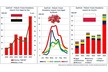
At a European level, the production of pears is decreasing. In 2006, 2.7 million kg of pears were produced in Europe. This year, a 2.3 million kg harvest is expected. “Apart from seasonal influences, there seems to be a systematic decrease in pear production in the traditional pear-producing countries,” Luc thinks. “With 723,000 tonnes (46% Abate) pears, Italy remains the biggest producer in Europe. It is decreasing though, by 25% in 10 years. The Conference production even went down by 50% in the last decade. Spain remains the second pear producer, but production there also decreased by 30% in the last 10 years.” With a production of 150,000 tonnes, France and Portugal share the third position. The French production was still 246,000 tonnes in 2006.
Conference is a strong grower
86% of the Belgian pear plantings are Conference. 40% of the European pear production consists of Conference, 72% of which in the Benelux. That undoubtedly makes Conference the leading pear variety in Europe. It’s also the only variety that’s growing. “This is of course related to the commercial success of this variety, and the fact that growers in the Benelux generally supply good quality,” Luc says.
The markets
“At the 2014 Prognosfruit convention that took place in Istanbul, the mood in the fruit sector was decidedly negative,” Luc says. “An extraordinarily high pear production was estimated. And at that moment, Russia has closed the door to European agricultural produce. The sector was stuck with 250,000 tonnes of pears that would traditionally go to Russia. In short, the misery was complete. Still, the sector recovered fast. The European Commission established a safety net that worked well. All in all, 380,000 tonnes were not harvested or taken off the market, causing pressure on the market to decrease. In Belgium, 587.53 ha was not harvested.”
Luc also saw support from public opinion: “This led to higher consumption of the exceptionally low-priced pears in Europe. From September until May, the consumer bought significantly more pears, meaning the loss of export to Russia was partly compensated. We also see that Belgian exporters have put in exceptional efforts, causing significantly more pears to be sold in the ‘traditional European countries’. The export of pears to Spain increased from 11.3 million kg to 17.8 million kg, to France from 23.6 million kg to 30.1 million kg, and to Scandinavia from 12.8 million kg to 19.4 million kg. Finally, new markets also opened, such as Canada, China and India. The favourable dollar-euro exchange rate contributed here.”
For more information:
Boerenbond
Luc Vanoirbeek