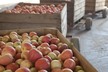
Paraguayo peaches are a variety that was created from hybridization. It's the same situation as its ancestor, which arrived to Europe from the Persian Gulf. In Portugal they call it pêssegos, and in Galicia the name péxegos is used for the fruits from wild peach tree, which are planted ungrafted and have become one of Galicia's autochthonous fruits. Persia was only a stopover point, not its origin. Like many other fruits, they originally arrived from China, which also applies to the mutated variety with a flattened shape currently known as Paraguayo peaches.
Numerous peach varieties are grown and it has integrated so well in the Mediterranean coast, that it is possible to find it all the way from the south up to Catalonia, Aragon and La Rioja. They are also cultivated in Galacia, although not without difficulties. Trees are very sensitive to fungi that affect them in the region's acid soil and humid climate.
For a decade or so, Paraguayo peaches have seen the emergence of a relative: the Platerina, which simply said is a peach with the skin, crunchiness and juiciness of a nectarine and the sweet and delicate flavour of a Paraguayo peach. This engineering, developed in Spain, has nothing to do with GM crops. Crosses to produce new varieties and improve existing ones are as old as agriculture. And in terms of peaches and derivatives, just like it happened with nectarines in the past, there is a huge range, sometimes due to natural acclimatization, others as part of the search for adequate fruits for fresh consumption, for preservation, for jam production, etc.
Paraguayo peaches and Platerinas, however, are mostly consumed fresh. They are not particularly suitable for processing or prolonged storage in chambers, as a result of which they usually have the best aroma and flavour within the peach family. Their price also remains relatively stable during the short season, shorter in the case of Platerinas, which is limited to the months of July and August.
Source: laregion.es