The HLB phytopathy (citrus greening or Huanglongbing) is an alarming phenomenon, but what is the risk for the Italian citrus industry? Vittoria Catara, phytobacteriologist and professor of Phytopathological Biotechnology at the University of Catania, who for years has been following the developments of this disease in the international context caused by phloem bacteria, spoke on this subject.
 Vittoria Catara
"The Asian citrus psylla, a quarantine organism from the EPPO countries, has arrived on the Mediterranean shores. The Israeli government has in fact communicated at the end of January 2022 that the samples of the insect collected in July 2021 in the citrus area of Hafer Valley (Netanya) are traceable to Diaphorina citri, a quarantine organism so far not present in the Mediterranean area and dangerous vector of bacteria associated with Huanglongbing (HLB) or Greening, unanimously considered the most dangerous disease of citrus".
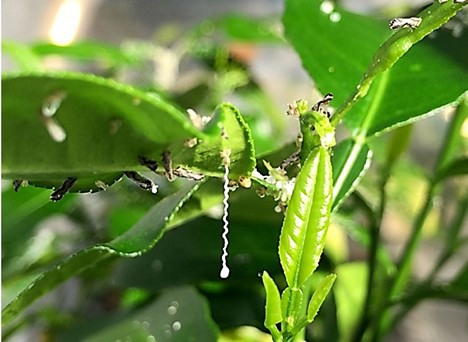 Diaphorina citri: Adults (2-4 mm) are brown in color with partially pigmented wings; juvenile stages are light yellow brown with prominent winglets and secrete distinctive white waxy tubules on leaves and shoots (Photo courtesy of Marco Pitino, Florida, US).
"HLB-associated liberibacters (Candidatus Liberibacter asiaticus, Ca. L. africanus and Ca.L. americanus) are an economic, environmental and social threat for all citrus-growing countries," Catara continued. "Accordingly, in October 2019, the European Commission included them in the list of twenty quarantine organisms considered a priority."
During the interview with the professor, it emerged how this phytopathology, also called yellow branch disease, because of the symptoms which affect the leaf apparatus, leads to a progressive deterioration of the plants, consequent to the reduction of the root apparatus, causing their death, independently from the rootstock used.
The affected plant fruits are small, asymmetrical, and show a persistent green coloration when ripe, which is prevalent in the stylar end. The juice retains a low ratio between sugar content and acidity, which makes it unusable. In some countries, production losses (and entire citrus growing areas) because of HLB are as high as 80%.
"Fortunately, at the moment - clarified the researcher - the arrival of D. citri, which is flanked by Trioza erytreae, another efficient vector of HLB ascertained in 2015 in the Iberian Peninsula (Portugal and Northern Spain), is not associated with the introduction of the bacterium (analysis possible only through molecular techniques), which is still absent in the Mediterranean basin."
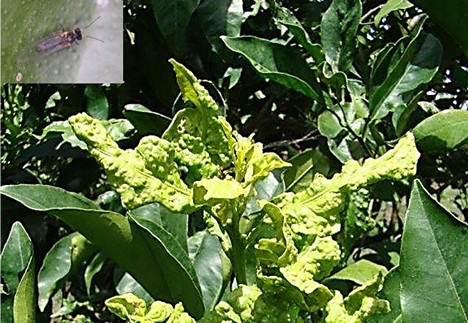 Above: Trioza erytreae: the adult is about 4 mm long, dark brown in color with well-developed transparent wings; juvenile stages are yellow, flattened and fixed on the leaf surface on which they cause scattered galls and blisters (Photo courtesy of Felipe Siverio de la Rosa, Canary Islands, Spain).
"However, the presence of the two insects and their ability to adapt to Mediterranean climatic conditions is an important sign. Regardless of the restrictive phytosanitary legislation, the liberibacter and the vectors could be conveyed in free areas through plants or twigs of species used for food purposes such as Murraya koenigii and Citrus hystrix imported outside the official trade routes also accidentally by unaware travelers. Just C. histrix (combava or Keffir lime) seems to be the origin of the introduction of D. citri in Israel," warned Catara.
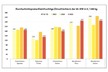
According to Catara, at the moment there are three scenarios that could directly impact us, with a different outcome if only the vector or the bacterium, or both, were to be introduced.
Possible scenarios following the introduction of the vector or the bacterium
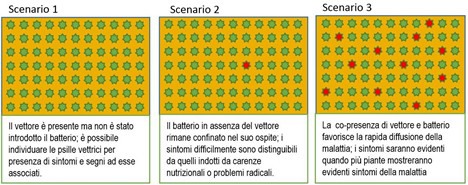 The figure above represents the possible scenarios resulting from the introduction of the vector or the bacterium without knowing it, as for example through plant material introduced introduced by amateurs in residential areas.
Because of these scenarios, prevention is currently the only valid tool available. As a matter of fact, while there are many studies to fight the disease, no valid cure exists to date, neither are there any known tolerance factors useful for long-term management. Informing citrus operators and the population about the risks is of paramount importance, as the symptomatology is not distinctive before the bacterium reaches a widespread diffusion.
"With regard to prevention, EFSA has drawn up a 'Pest survey card' in 2019 that indicates the agreed methodology to be adopted, based on the monitoring of the territory, moreover, initiated by the Phytosanitary Services. This must involve not only production citrus groves but must be extended to residential areas and ornamental citrus. Suffice it to say that in several U.S. states the first reports have occurred in residential areas rather than in commercial plants, while in other cases the disease was reported a few years after the discovery of the vector," explained entomologist Giuseppe Massimino Cocuzza, professor of Entomological Biotechnology at the University of Catania, Sicily.
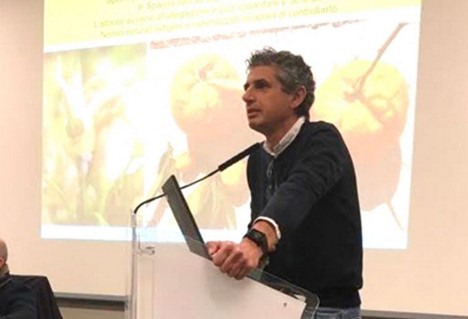 Giuseppe Massimino Cocuzza
"A widespread campaign to alert and raise awareness is needed so that all operators in the sector contribute to the supervision of the territory. The key elements to consider are visual inspections aimed at detecting the symptoms of the disease, direct damage induced by vectors (formation of galls as a result of the stings of T. erytreae) or the presence of the insect itself (presence of adult individuals of D. citri and the formation of obvious waxy formations produced by the neanids)," concluded Cocuzza.
*The images contained in this article have been provided by Prof. Vittoria Catara.
For more information:
[email protected]