Despite forecasts made by analysts that container shipping would return to normal after the Chinese New Year, there still hasn't been a slowdown in the massive flow on the trans-Pacific route.
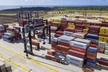
As noted by maritime industry analyst Jon Monroe in his weekly report, bottlenecks in the US supply chain continue as there is a fleet competing for a berth in the Los Angeles-Long Beach port complex, where an average of more than thirty vessels -that have an average size of 9,000 TEU- wait to berth each day. Last year, almost 60% of all Chinese imports to the US entered the country through the two southern California ports.
The shortage of chassis for transporting containers on land continues to be problematic and there are delays in getting equipment onto the rail. "Our import supply chain is totally broken and disconnected. The issues on imports had an impact on exports. In their attempt to quickly take empty containers to China to move Asia's highest-paid cargo, shipping lines decrease the reserves of most US exporters," Monroe stated.
The problem, it seems, will continue as the slowdown in the flow of shipping due to the Chinese New Year holiday won't be enough for a demand that is expected to remain strong in the first half of the year, the analyst said.
Shipping lines
Shipping lines seem to admit there won't be a slowdown in the increase in volume driven by the pandemic. They do expect a slight respite during the Chinese New Year, due to the lack of truck drivers in the country and, consequently, the supply of cargo from the ports.
Maersk recently announced that their fourth-quarter EBITDA increased by 96% over the same period of the previous year. "This is not a surprise. Ocean freight rates have almost tripled and premiums have been added to guarantee container and space. Although there will be a slight respite as ships unload empty containers during the China holidays, reserves are expected to become strong again and this increase is expected to continue during the period in which contracts are negotiated," Monroe said.
The new contractual fees are expected to stand at around $ 3,000/West Coast FEU, $ 4,000/East Coast FEU, and $ 5,000/FEU IPI, Monroe noted. This is twice as much as last year, but it is roughly half of what BCOs and NVOCCs currently pay.
Source: mundomaritimo.cl