When the Canadian Produce Marketing Association's 2026 board of directors met last week for the first time ahead of the annual trade show and conference, Equifruit's Jennie Coleman noticed something in the room. "I was reelected so this is my second term and we now have nine women on the board," she says. "When I started three years ago, there were just five of us. There's still an incredible number of men–there are 34 of us all together–and if you look at this without a comparative lens, it doesn't look very impressive. However if you see how much more female representation there is, it feels pretty empowering."
As it should be given that the "Law of the Magic Third" can almost be applied to this situation. The notion, made popular in author Malcolm Gladwell's 2024 book Revenge of the Tipping Point, notes that when a minority group reaches approximately one-third of the total representation, there's safety in those numbers. "You feel more empowered to speak your mind and to feel like you're representing a legitimate constituency because there's enough bench strength to back you up. It may not be half and half–but it's enough that that segment can't be ignored or dismissed and I feel really happy about that," she says.
 © EquifruitEquifruit's Jennie Coleman.
Progress still underway
While there's still a ways to go–the International Fresh Produce Association's Board of Directors is closer to parity with its board of directors–celebrating the progress with this year's CPMA board is important. "We have to keep working to continue to make female leadership in produce visible and recognized," says Coleman.
After all, there are notable benefits to having women-led companies. Coleman believes that Equifruit has different goals than traditional male-led organizations for example. "We're very mission-driven and we likely have a more collaborative approach with our team," she says. "Our success is about this great team of people who have been given a path and are motivated to follow it. Everyone who joins the company goes through an adjustment to our culture because it's different. Perhaps there's a bit less of an emphasis on the bottom line and more of an emphasis on running a business that meets the needs of a broader swath of people."
The case could be made that women-led organizations in produce can also connect more closely to those who predominantly shop for food for their households: women. "It's probably a good idea to have some women leaders who represent that majority of shoppers and can think about what resonates with that female customer," says Coleman.
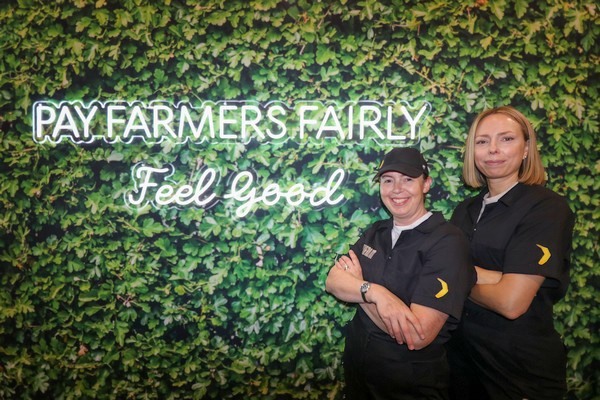 © EquifruitColeman with co-owner Kim Chackal at the 2025 IFPA's Global Produce & Floral Show.
Resonating with customers
That very notion was proven relatively recently for Coleman. While it hasn't always touted these benefits, not only has Equifruit been a 100 percent Fairtrade company since its inception, but since 2024 it has also been a certified B Corporation company along with being women-led, certified by WEConnect International in 2023–in all, a triple threat.
"We've started to lean into the women-owned characteristic. When we launched with the Pattison Food Group in Western Canada earlier this year, the point of sale material went up in Save-On-Foods that emphasized these three pillars," says Coleman. To her surprise, consumers really responded to this positioning. "I had two people look me up on LinkedIn and they didn't even talk about Fairtrade. They were just responding to the fact that we're a women-owned company. So we are realizing that there's power in that."
While women-led is growing in the industry, what is still lacking is women-owned companies which is another unique positioning point for Equifruit which is co-owned by Coleman and Kim Chackal, who is also the company's vice president of sales and marketing.
In all, things continue to progress in being a women-led company. "We are less 'banana-splained' to–when someone talks down to us about the banana industry," says Coleman. "It still happens but it's a bit less. In all, I hope that this all breaks barriers for younger women and that it's an example of a path in produce for them. That's what I really hope."
 For more information:
Georgia Crump
Equifruit
Tel: +1 (833) 511-3247
[email protected]
www.equifruit.com