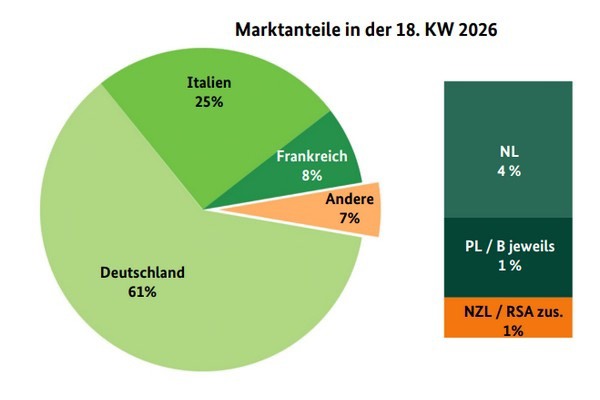
Domestic Elstar, Braeburn, and Jonagold formed the core of the assortment. Imports from Italy consisted primarily of Pink Lady and Golden Delicious. France contributed mainly with Pink Lady and Jazz, which were generally presented in pre-packaged form. Supplies from the Netherlands, Belgium, and Poland played only a minor role. Although overall availability had decreased somewhat, it was sufficient to meet demand. According to the German BLE, the quality of the loads was mostly still satisfactory. In terms of pricing, there was not much movement: minor price increases were recorded for German storage apples, but there were no major outliers.
 © BLE
© BLE
The overseas season began with the arrival of the first New Zealand Smitten. The first South African Granny Smiths also appeared: in Frankfurt, they were offered at 31 EUR per 18-kg box. Imports from the Southern Hemisphere are expected to increase. The first Royal Gala is already in the starting blocks.
Click here for the full market and price report.
Pears
South African shipments dominated the market. Packham's Triumph and Cheeky led the way. Abate Fetel, Rosemarie, and Forelle played a secondary role but mostly attracted sufficient attention. Shipments from Argentina and Chile rounded out the overseas supply and generally maintained their previous high prices.
Table grapes
South African and Chilean loads dominated. Indian and Peruvian loads supplemented the market, though their availability was apparently limited. Demand was rather subdued and easily met. Quality was generally still satisfactory. Nevertheless, sales were sluggish.
Strawberries
The availability of domestic loads had expanded noticeably and displaced Greek offerings from the top spot. Dutch imports also increased. Italian, Spanish, and Belgian loads supplemented the supply. Demand had increased as a result of the holiday.
Lemons
Spanish Verna lemons now dominated the market and had almost completely displaced Primofiori lemons of the same origin. South African Eureka lemons served as a supplement; they were typically of good quality and thus cost up to €33.50 per 15-kg box in Hamburg.
Bananas
Only Berlin reported stable prices. In Hamburg, storage capacity had improved due to the marathon, allowing traders to raise their asking prices slightly. In Frankfurt, prices for second-tier brands rose, while those for third-tier brands fell slightly.
Cauliflower
Germany, Belgium, and France were the main suppliers. Deliveries from Italy, Spain, and the Netherlands supplemented the supply. In general, business proceeded at a steady pace. Some loads were too small, so they did not generate sufficient demand. Discounts nevertheless ensured a smooth turnover in such cases.
Lettuce
Iceberg lettuce came almost exclusively from Spain, and supply had decreased slightly. With favorable demand, prices edged down slightly, but sales were brisk. The domestic season began in Hamburg: customers were expected to pay €11 per 10-pack carton. For mixed leaf lettuce, domestic loads dominated over Belgian and Italian ones.
Cucumbers
The assortment of cucumbers consisted of Dutch, Belgian, and domestic shipments. In Frankfurt, supply was too abundant, causing prices for foreign loads to drop. They did not stabilize again until the weekend. In Munich, prices fluctuated but ultimately trended upward.
Tomatoes
Round tomatoes came primarily from Belgium and Spain, while cherry tomatoes came from Italy and the Netherlands. Vine tomatoes were mainly sourced from the Netherlands and Belgium. Beef tomatoes were predominantly supplied from Belgium. Retailers often offered discounts to quickly move the abundant supply.
Bell peppers
Dutch and Belgian produce dominated over Turkish. The season for Spanish loads was entering its final stretch, and deliveries were noticeably limited. Prices developed unevenly: Belgian and Dutch offers frequently became pricier, while Turkish and Spanish ones frequently became cheaper. However, no clear trend was discernible.
Asparagus
Domestic loads clearly predominated for white, purple, and green asparagus alike. Imports from abroad played, if at all, only a very minor role. Thus, in addition to domestic green asparagus, Spanish, Italian, and Polish varieties were available. For white asparagus, there were Polish, Dutch, and Italian varieties.
Source: BLE