It's been a tough year for the North American potato industry, driven by oversupply and rising input costs. "Oversupply has been particularly evident in russets and reds in the U.S. market, putting real pressure on pricing and movement across the broader North American market," says Andrew George, Chief Sales and Procurement Officer with EarthFresh. Fortunately, Canada has been somewhat insulated from this due to strong domestic retailer support for locally grown product.
Regionally, the story considerably varies from coast to coast. Western Canada enjoyed one of its best crops in recent memory while Eastern Canada was hit hard by drought, significantly reducing yields. Altogether, this has made for a very dynamic year. "Moving into spring, we're finally seeing some market activity pick up," shared George. A freeze in Florida impacted local supply, and conditions are shifting faster than at any point since the start of the harvest season. Supply of yellow potatoes is tightening across both Canada and the U.S., a trend worth watching as the season heads into the warmer months.
 © EarthFresh
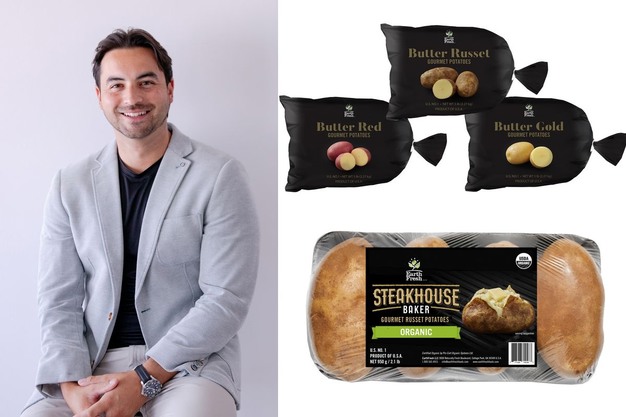
Left: Andrew George. Right: Butter Potatoes and Organic Steakhouse Baker Potatoes.
Fertilizer costs up 50 percent
On top of oversupply, the impact of increased input costs has been substantial, felt up and down the supply chain. Many growers across Canada and the U.S. were unable to lock in fertilizer pricing before geopolitical events drove costs up sharply, in some cases by as much as 50 percent. That sets up a very expensive growing season with limited ability to absorb those increases. Trucking has added another layer of pressure. A shortage of cross-border drivers has created capacity constraints and driven rates higher, with fuel costs compounding the problem further. "There is no easy path around these cost realities."
Move towards branded products
Within this challenge, however, is a real opportunity for companies that have invested in differentiation. "We've deliberately built programs that move away from the commodity shelf and toward variety, taste, and branded consumer experiences." Overall potato consumption is flat, but the story within the category is more nuanced and quite encouraging for EarthFresh. Russets and reds continue to lose ground, declining one to five percent year over year. That's a structural shift showing no signs of reversing. Baby potatoes, however, are growing at approximately six percent annually and yellows at around three percent.
The red category has shrunk from 18 percent of market share a decade ago to roughly 10 percent today, while baby potatoes have grown from 11 percent to 21 percent of the overall market, and yellows have climbed from 10 percent to 16 percent. "We see baby potatoes reaching 25-30 percent of the market and yellows hitting at least 20 percent over the next ten years. The trends are clear: consumers want more from their produce and potatoes are no exception. EarthFresh is confident its portfolio is well-positioned and aligned with the direction the category is heading.
Value-added products
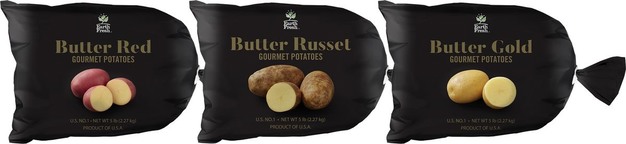
Within EarthFresh's value-added category, the response to the company's Butter Potato program has been exceptional. Consumers are responding to the consistent taste, exclusive variety selection, and predictable quality week after week. "Our Butter Potato program has recently expanded into foodservice and is now appearing on restaurant menus, delivering a consistent fry with low sugars that operators need."
Data tells that younger consumers become the primary household purchasers and their expectations have shifted firmly toward taste and variety. EarthFresh's Potatoes of the World program, organics, and variety programs are all designed to meet that demand. On the organic side, consumption has grown approximately 30 percent over the past five years, and investments in a 52-week program continue. In addition, the launch of new organic products supports long-term growth in the category. Currently, EarthFresh is preparing a major summer marketing campaign around its Steakhouse Russet program, bringing a premium steakhouse experience to the home cook.
 © EarthFresh
Access to Mexico
Another positive development is that Canada recently gained access to the Mexican market. The Canadian Food Inspection Agency (CFIA) recently reached an agreement with Mexico's food safety authority, allowing shipments of Canadian potatoes for consumption or processing into Mexico. "This is genuinely exciting news for Canadian potato growers as for the past 20 years, the U.S. was the sole supplier of potatoes to Mexico," commented George." Having a new international outlet gives Canadian growers another avenue to move product. Diversification is critically important right now given how uneasy international trade has been the past year. While EarthFresh is excited about the possibilities, it's still early days. "Nevertheless, we are well positioned to capitalize on this opportunity and look forward to sharing more as the program develops."
CPMA
This week, CPMA holds the 101st edition of its Annual Convention and Trade Show, taking place from April 28 to 30 at the Metro Toronto Convention Centre, right in EarthFresh's backyard. The company will be showcasing its full range of differentiated programs: Butter Potatoes, Steakhouse Russet, its new air Fryer Kit and much more. "For us, it's a great opportunity to connect with retail and foodservice partners, share where the category is heading, and show why an innovation-led approach is the right path forward for potato programs in Canada," said George. Visit the team of EarthFresh at booth #509.
 © EarthFresh
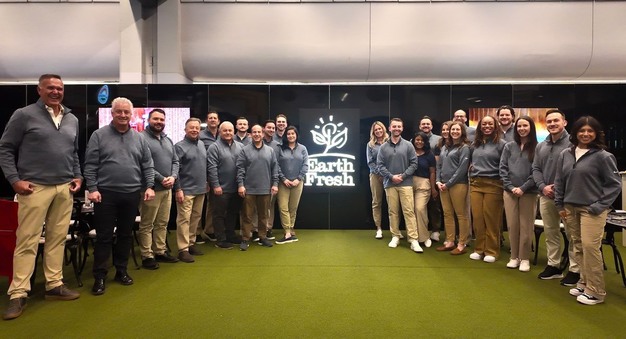
Team EarthFresh at CPMA 2025.
 For more information:
Anneka Jenkins
EarthFresh Farms
Tel (+1) 404-593-9865
[email protected]
www.earthfreshfoods.com