Cherry seasons move fast. From harvest to retail-ready packs, packers operate in a narrow window where line speed, product integrity, and labor efficiency all must perform simultaneously. A single bottleneck, such as a reject jam, a belt failure or a sorting slowdown, can cost thousands of pounds of throughput in a matter of hours.
That reality has pushed cherry packers to rethink conveyance across every zone of the packing line, from intake through palletizing.
Avoid de-stemming with S900 Mesh Top Belt
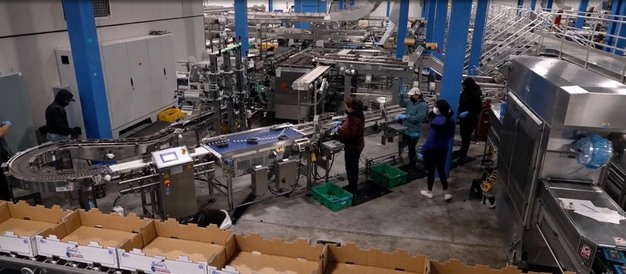
In cherry packing operations, maintaining product integrity during conveyance is a constant challenge. Traditional belts can snag stems, drop fruit at transfer, and complicate cleanup, all which chip away at yield and slow the line. Cherry packers looking to protect delicate cherries while keeping throughput high are turning to Intralox's S900 Mesh Top belt to solve these issues at the source. Designed to avoid de-stemming, the S900 Mesh Top combines a large open area with relatively small openings, allowing efficient water drainage while securely retaining cherries on their stems as it moves towards the grader. Its tight-transfer design – enabled by a smaller sprocket and minimal drop height – prevents fruit from falling between conveyors at the outfeed, directly improving yield. Lightweight, easy to handle, and simple to repair, the modular belt delivers long belt life while reducing product damage and supporting smooth, reliable operations.
 © Intralox
Automating the reject process
During primary packaging, the reject process has traditionally required workers stationed at the line to manually pull over and underweight packages, clear jams, and realign product. Fixed rails and mechanical pushers generate impact that can damage clamshells, cause misalignment, and slow the line at exactly the moment throughput matters most. Stemilt Growers, a North America cherry packer and provider in Washington state, faced those challenges head-on.
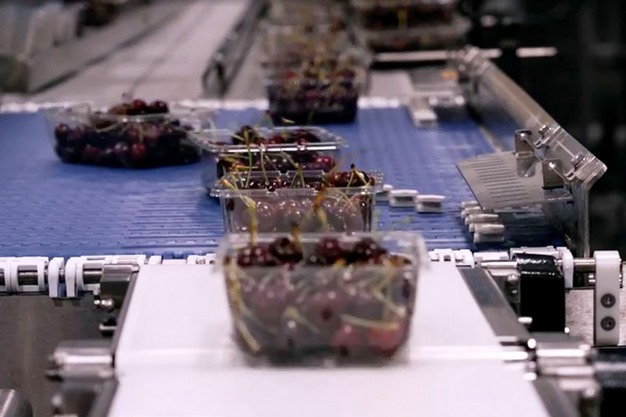
Working with METTLER TOLEDO and Intralox, Stemilt implemented a fully integrated solution pairing automatic clamshell fillers, METTLER TOLEDO checkweighers, and four Intralox Active Integrated Motion (AIM) Switch units for rejecting — two per line — to manage rejection on two cherry packing lines.
The results were significant. Throughput increased to 12 tons per hour of consumer packages, a gain of 5 to 6 tons per hour, while line capacity climbed 57 percent, from 35 clamshells per minute to 55. Labor requirements at the reject process dropped from 10 workers to four, a 60 percent reduction. Since installation in 2018, the system has required no repairs and has experienced zero unplanned downtime.
The AIM Switch uses moving pegs embedded in the belt surface to guide product between lanes without fixed rails or mechanical pushers. Because the pegs move with the belt, they maintain product orientation and eliminate the blunt impact that misaligns clamshells at speed. The system requires no lubrication, is designed for washdown, and can operate at line speeds up to 200 feet per minute.
 © Intralox
METTLER TOLEDO for cherries.
Hygiene and the ThermoDrive advantage
Across all zones of a cherry packing line, hygiene is non-negotiable. Intralox ThermoDrive belting addresses that requirement with a solid thermoplastic structure that eliminates the tensioning mechanisms and fabric construction where contamination risk accumulates in traditional flat belts.
ThermoDrive's tensionless, positive-drive system improves belt tracking, extends belt life, and significantly reduces both cleaning time and water consumption — important considerations for facilities managing wash cycles around shift changes or seasonal startup and shutdown.
Back-End automation: secondary packaging and palletizing
For handling boxes of cherries, belt reliability is a foundational requirement. Rod migration and edge breakage can shut down entire conveyor sections when multiple conveyors share a drive shaft, multiplying the cost of a single component failure. Intralox Series 2400 Radius Heavy-Duty Edge (HDE) belting, engineered with a Load-Sharing edge design that distributes stress across links, has been deployed to eliminate both failure modes. In documented applications, the solution has been projected to eliminate 48 hours of unplanned downtime annually while saving up to 33 labor hours per month in planned maintenance.
At the back end of the line, Intralox Activated Roller Belt (ARB) technology and Dual-Stacked Angled Roller Belt (DARB) sorters enable touchless, high-speed sorting for secondary packaging and palletizing — feeding cartons to robotic palletizers with consistent, gentle flow. ARB technology allows for optimal box and case movement between secondary packing machines and palletizing stations, in a touchless, high-speed fashion that helps avoid product damage, eliminates unplanned downtime, and generally occupies a smaller footprint than conventional solutions. Prior to installing their AIM Switch solution, Stemilt first saw success with Intralox Dual-Stacked Angled Roller Belt (DARB) Sorters and Activated Roller Belts (ARB) Sorters S7000 for sorting packed cartons in their palletizing area. In another application, a combined ARB Merge and DARB Sorter deployment enabled a 66 percent increase in production volume while optimizing carton flow to palletizing stations.
Planning ahead
For cherry packers evaluating conveyance investments ahead of the next season, early-stage line layout consulting, combined with simulation tools that model switching and sorting configurations before equipment is installed, allows packers to validate the approach before committing capital. The shift toward automation on cherry packing lines reflects a broader movement across fresh produce: as labor availability tightens and consumer expectations for product quality rise, the cost of a poorly designed or unreliable conveyance system is no longer just a maintenance expense. It is a competitive liability.
 For more information:
Fruit & Vegetable Customer Service
Intralox
Phone: (+1) 888-422-2358
[email protected]
www.intralox.com