Located in Matina, on the Caribbean coast of Costa Rica, Varcli Pinares competes as a small-scale family-owned banana company on quality, sustainability, and brand identity rather than volume. Starting from a position of limited land and funding, Varcli developed an integrated model in which water efficiency, soil health, solar energy, biodiversity conservation, and social responsibility are woven into the production logic itself. The company's ability to bring its own branded product into Walmart's U.S. stores is perhaps the clearest evidence that this approach is commercially viable.
For years, Varcli sold its fruit through the standard transnational route, most recently through Del Monte. Around 2016, the company made a strategic break from that model. "Farm-gate prices were just too low," explains Olman Andrés Vargas Climent, responsible for marketing, data analytics, and research. The shift was towards direct contracts with retailers, starting in Germany and expanding over time to the UK, Italy, Japan, the United States, and several other markets.
 © FreshPlaza
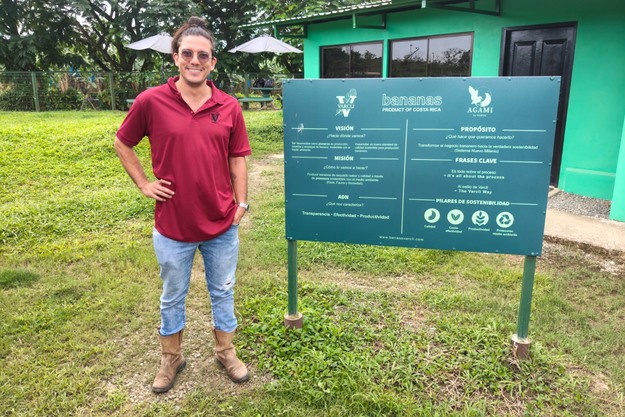
Olman Andrés Vargas Climent, head of marketing, data analytics, and research
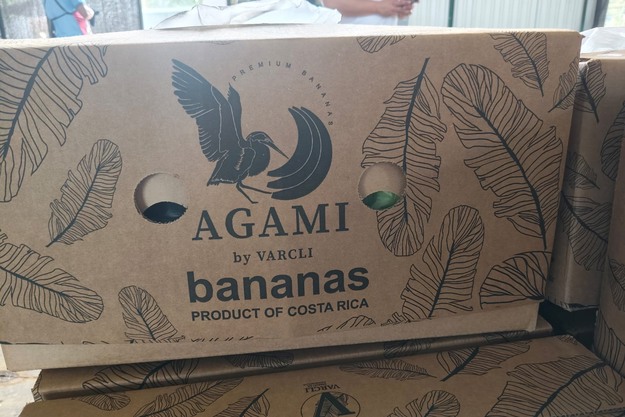
The most notable relationship today is with Walmart. Varcli started supplying one container per week and has since grown to approximately seven. The strategic target is to represent 1% of Walmart's total banana volume. Crucially, Walmart was the first major retailer to allow Varcli to sell under its own brand rather than as a generic commodity, with branded stickers in Walmart's specialty outlets in Texas and Florida. "The Walmart relationship is genuinely collaborative. We work together in sustainability summits and joint research programs", Vargas Climent says, adding that Varcli participates in Walmart's Project Gigaton carbon reduction initiative.
Sustainability born from efficiency, not ideology
One of the most striking aspects of talking to Vargas Climent is how he frames the company's green credentials. There was no founding environmental manifesto. "It didn't come from an ideological point of view," he says. "It really started from: let's make ourselves as efficient as possible while being able to protect quality."
 © FreshPlaza
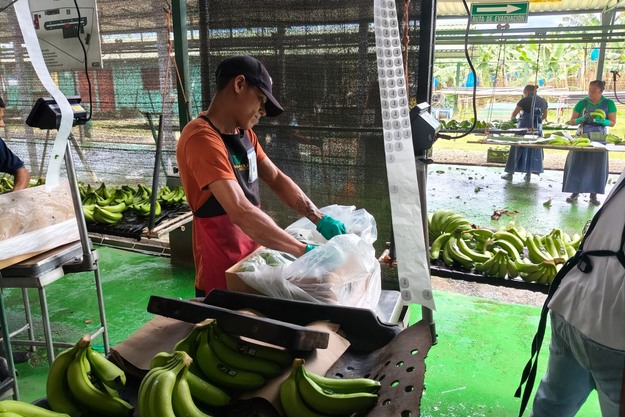
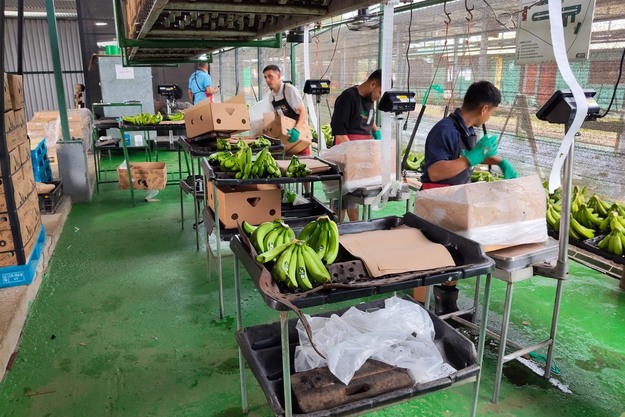
The most significant technical innovation is the elimination of water pools in the packing house. Conventional wisdom holds that bananas must be submerged to remove latex after cutting. Varcli challenged that assumption entirely, redesigning the packing process so that latex drains naturally from the cut handle without immersion. The result: a 90% reduction in water use, saving around 36 million liters per year. "If you make the sums," Vargas Climent says, "it's really, really important."
Removing the pools also slashed energy consumption — the pumping infrastructure simply disappeared. Today, the packing house runs off-grid on solar power. "We've been off the grid. Since ever," he says. All organic residues from packing are returned to the fields, eliminating waste disposal entirely.
 © FreshPlaza
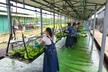
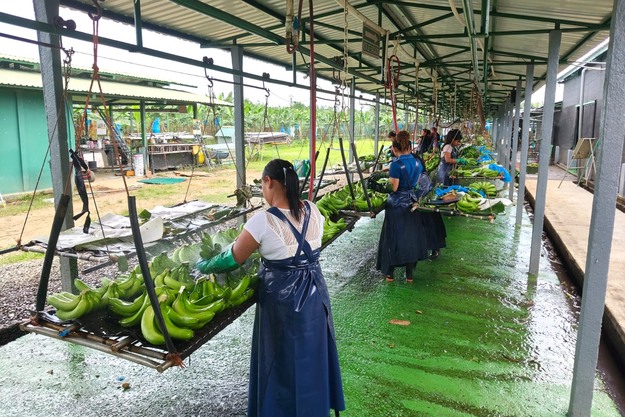
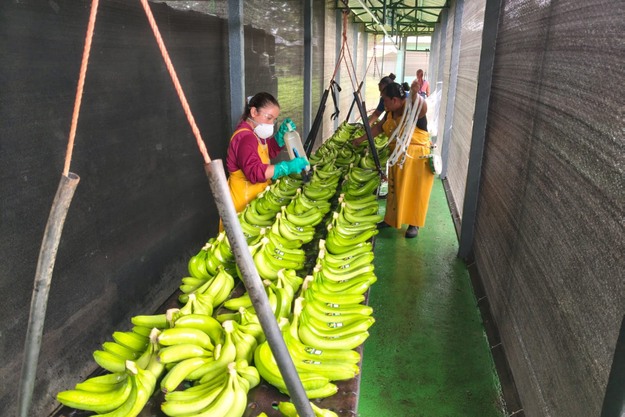
The banana bunches are not transported to the packing center hanging from hooks on a rail; instead, they are cut directly into hands in the field and carried on stretchers to the packing station. The latex already drains during the journey, so at the packing station, only a small additional rinse is needed, without any need for water pools. The water savings are considerable. This system, developed by Varcli itself, is unique in its kind. Banana growers interested can contact the company for more information.
Soil, spacing, and surprising yields
A second strand of innovation concerns how the farm is managed at ground level. For about nine years, Varcli has avoided planting cover crops between the banana plants — a common practice elsewhere. Instead, the farm is physically mowed throughout, allowing natural biodiversity to establish itself organically. "You avoid introducing a whole new layer of management complexity," Vargas Climent explains. Herbicide spraying has been reduced by 95%, replaced by a specialized small team of four workers.
Linked to this is Varcli's unusually low planting density: 1,333 plants per hectare, well below the Costa Rican average of 1,600 to 1,800. The reasoning is straightforward: at higher densities, overlapping leaves reduce sunlight and airflow, diminishing individual plant productivity. Space them out, and each plant grows faster and gives larger bunches. Despite the lower plant count, the farm consistently achieves close to 3,800 boxes per hectare. "You could say that we actually do a little bit more boxes than the average," Vargas Climent confirms, with evident satisfaction.
 © FreshPlaza
Alongside the 150 hectares of banana plantation, the company manages 80 hectares of reforestation — planted with Melina trees, originally intended for self-sufficiency in pallets and industrial materials — and 100 hectares of fully protected rainforest. Both the reforestation and the protected forest serve as carbon sequestration sites, and the farm is running a carbon footprint assessment to emphasize its net-zero carbon emissions from production.
Drones, disease, and biodiversity in the soil
Varcli was an early drone adopter for Sigatoka disease control, starting around nine years ago when tanks held just 10 liters. Current drones carry up to 100, making the process far faster and more cost-efficient.
On the more existential threat of TR4 — the fungal disease that is quietly spreading through banana plantations worldwide — Vargas Climent puts his faith in soil biology. "What we are doing, besides all the tracking... we work a lot in terms of biodiversity in the soil." The logic is that in a biologically rich environment, an introduced pathogen like TR4 faces fierce competition from existing fungi and microorganisms, making it harder for the disease to take hold.
 © FreshPlaza
A brand with a heron on it
Varcli's farm sits adjacent to a government-protected coastal strip that is one of the world's most important nesting sites for the leatherback turtle. The company supports three conservation organizations working in the area. But it is another creature that has become the company's symbol: the Agami heron, a rare and strikingly colored bird whose only known accessible nesting site lies on or near the farm's land. The heron now appears on Varcli's branded stickers.
People: Women in the field, migrants in the workforce
Around 100 people work on the farm, a significant proportion of them Nicaraguan migrants. Varcli provides transport and above-average wages, and actively helps workers regularize their legal status in Costa Rica. The labour market is increasingly tight. "The root cause," Vargas Climent says with a degree of philosophical resignation, "is that young people really don't want to do these kinds of jobs."
One response has been a deliberate effort to employ women in field roles, including a dedicated all-female team for leaf sanitation. The packing house workforce is around 80% female. The motivation is partly practical — female workers have proven to be more stable long-term employees — but Vargas Climent also sees a broader social dimension. Many are single mothers in rural communities. "I really do think it's something that should be growing more, and hopefully we're gonna have a really good impact on the towns."
 © FreshPlaza
Plastic waste: a national recycling system
Like all banana producers, Varcli uses large quantities of plastic bags, ties, and other packaging materials. In Costa Rica, 100% of this plastic is recycled through Reciplast, a company jointly founded in the 1990s by the three major banana multinationals (Dole, Chiquita, and Del Monte) specifically to capture and process agricultural plastic waste. The collected plastic is converted into corner boards and other sub-products. The recycling plant is located near the farm in the Siquirres area.
Surviving the present, exporting the model
Physical expansion in Costa Rica is no longer realistic. The country has reached 62% forest coverage, and new agricultural land is simply not being released. Varcli's growth strategy, therefore, focuses on exporting its production model to partner farms in other countries.
But first things first. Climate unpredictability — the forecast for a neutral year was revised within weeks to a full El Niño — is making production planning harder. And the strengthening of the Costa Rican colon — falling from around 620 to 480 colones per dollar over four years — has squeezed export revenues significantly. "The first goal right now," Vargas Climent says, "is to survive this year."
About the company
Varcli is a family business now entering its 17th year of operation. It was founded by Felipe Olman Vargas Vargas, Olman Andrés's father, a veteran of Dole with close to 40 years of experience in the banana industry. The company is led by Olman Andrés's brother, Felipe, and holds a full set of international certifications, including Rainforest Alliance, GlobalG.A.P., USDA, and FDA, and won G.A.P. awards in 2016 and 2018, and SEDEX awards in 2019.
 For more information:
Olman Andrés Vargas Climent (marketing manager)
Varcli Pinares SA
Matina, Limón (Costa Rica)
Tel.: +506 8367 3595
[email protected]
www.bananavarcli.com