Tight specifications in baby leaf spinach mean growers are often forced into a conservative harvest strategy, leaving yield in the field. Leaves that grow even slightly beyond the accepted size window fall out of spec, so crops are typically cut early to avoid rejection. Siddharth Jadhav of Polybee says that caution comes at a cost. Growers are "harvesting conservatively to stay within spec", he explains, even though the crop has not yet reached its full in-spec potential — effectively trading volume for certainty.
 © Polybee
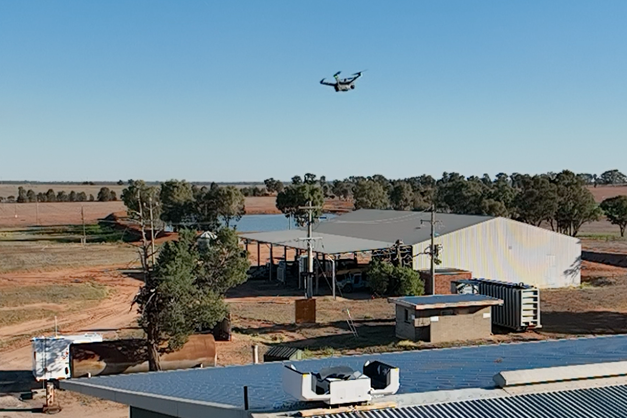
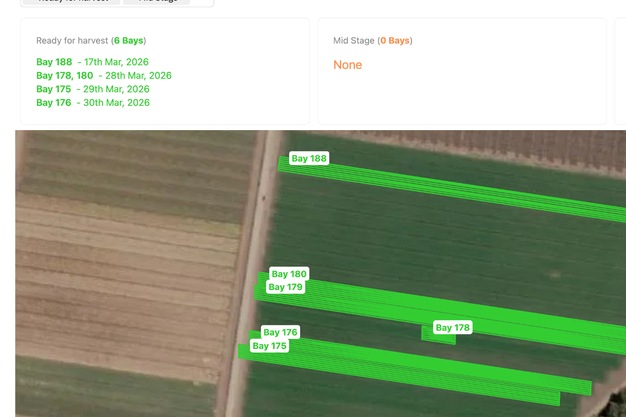
Polybee's approach is designed to remove that trade-off. The company deploys autonomous drones to capture high-resolution imagery across entire fields, replacing manual crop checks with full-field visibility. "We image every part of the farm," Jadhav says, with AI then used to measure leaf size and model growth rates. That allows growers to pinpoint the optimal harvest window with far greater precision. Rather than relying on instinct or averages, they can act on crop-specific data. "We can tell them exactly when to harvest for maximum in-spec yield," he says.
The gains are already measurable. Working with Aussie growers, Polybee has demonstrated a roughly 10% uplift in yield by aligning harvest timing more closely with specification limits. In a category where margins are tight and demand is relatively fixed, that improvement translates directly into higher returns. Instead of leaving usable crop in the ground, growers are capturing more of what they have already invested in.
The underlying issue extends beyond harvest timing. Across fresh produce, planting, and sales decisions are often made with incomplete information. "Growers commit to sales orders without knowing exactly what's in the ground," Jadhav says. Traditional methods rely on staff walking a handful of rows and extrapolating across the field — a process that introduces variability and risk. Polybee replaces that with a consistent, data-driven view of crop conditions, enabling more accurate forecasting and tighter alignment between supply and demand.
 © Polybee
While spinach has been the initial focus, the model is designed to scale. The same platform is already being applied to broccoli, with lettuce expected to follow this year. Development work is also underway in strawberries and blueberries. "The core system adapts across crops," Jadhav says, with expansion progressing in both Australia and the United States. The aim is to build a standardised layer of crop intelligence that can be deployed across different growing environments and product types.
Spinach has proven to be an effective starting point for a reason. Its short growth cycle — as little as 24 days in summer — allows datasets to build quickly, accelerating the refinement of AI models. It is also a high-value crop with little room for inefficiency. Demand is relatively stable, so gains in yield do not flood the market but instead improve grower margins. "Every efficiency gain goes straight to the bottom line," Jadhav says.
 © Polybee
By combining full-field imaging with predictive analytics, Polybee is attempting to shift decision-making from estimation to measurement. In a category defined by tight tolerances and limited flexibility, even small improvements in timing and accuracy can have a disproportionate impact on returns.
For more information:
Siddharth Jadhav
Polybee
Tel: +65 82459172
https://polybee.co/
[email protected]