"It's been ten days of nightmares, every hour something different," says an exporter who's been sending South African apples, pears and lemons to the Middle East since the beginning of the year.
"It couldn't come at a worse time," he says, referring to the Ramadan period observed by his clients who are suffering constant bombardment. He asks to keep his identity confidential. His company was fortunate to have containers on vessels inside the Strait of Hormuz when the war broke out. "Those we managed to get cleared, but we had to pay a big fat surcharge on each of those containers."
The War Risk Surcharge levied by shipping lines adds US$4,000+ to the cost of renting a reefer container. "We used to pay around US$3,600 for a container; now it's approximately US$9,200 per container. It's not only the surcharge, although that is a killer, but it's also the changing of destination (COD), changing the documentation."
The previous four weeks' containers are "floating around" outside the Middle East on the water, he says, waiting for instructions. Only MSC is offering a service currently, and they are calling at Jeddah (Saudi Arabia) and Aqaba (Jordan).
"The best prices in the world for fruit will be in the Middle East this year," he remarks. There are ways and means of getting fruit into the Middle East. "However, we don't know what's going on, and we don't know how long this will continue. All the information we receive is second or thirdhand."
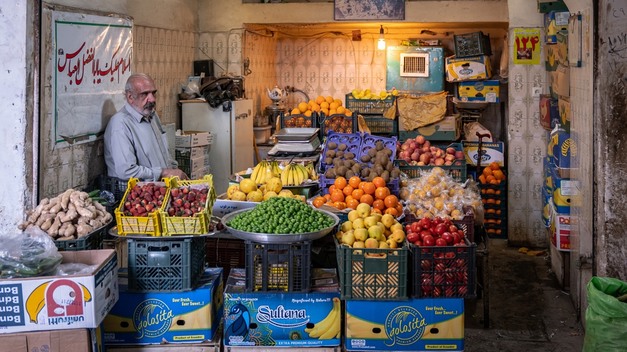 © Hakan Can Yalcin | Dreamstime
Iranian greengrocer in Isfahan, 2019
Consequent apple oversupply in Far East
For the moment, however, he says they expect a complete loss on the pears packed and shipped for the Middle East. Some South African apple exporters have diverted all Middle East shipments to the Far East and Malaysia, Hong Kong, Singapore, and these markets will, he says, be flooded with apples.
But bigger in volume than apples and pears is citrus. The prospect of not having the Middle East as a destination is hugely concerning to the citrus industry of South Africa. "Approximately 20% of Egypt's oranges will go into the Middle East, and we expect the balance to be shipped to Europe, which will be flooded by the time South Africa's citrus arrives. Egypt normally sends a lot to Bangladesh and India, but they can't get through the Red Sea, so all that volume will also be shipped into Europe."
He comments, "This has a bad effect on the whole planet, in my mind. Growers can't ship less. If anything, they'll try to ship more than last year. The orange juice price has drastically reduced by as much as three-quarters, even lower for other citrus categories."