In a constrained economic environment, purchasing patterns across South Africa's fresh produce sector are clearly shifting — and packaging sales are reflecting this reality. "The global economy is in a difficult space at the moment," says Tracy Joyce, managing director of Gerber Fresh, South African agent and after-sales support partner for several leading international packaging and food-grade processing equipment manufacturers.
Reflecting on this year's Fruit Logistica, Tracy notes that while sustainability continues to dominate international conversations, few radically new developments emerged. "The global trend is moving steadily toward cellulose-based, compostable, and biodegradable packaging solutions," she explains. "However, those materials come at a significant cost — often up to five times more than conventional packaging."
While such solutions are gaining traction internationally, South Africa's market realities differ. According to Joyce, local adoption typically trails global markets by five to six years, particularly where price sensitivity is high.
Shifting consumer buying patterns
Operational manager Steven Irving adds that the broader economic pressures facing the country — including low growth and high unemployment — inevitably influence buying behaviour throughout the value chain.
Jeanette van der Nest, chief business officer at Gerber Fresh, says the company's sales data clearly reflects tighter consumer spending. Historically, three-kilogram packs dominated their sales. More recently, however, one-kilogram packs have grown significantly in popularity - a strong indicator, she explains, of day-to-day budgeting among households.
"Sales of larger pack formats for staple lines like onions and potatoes have slowed. We're seeing stronger movement in one and two-kilogram packs, rather than five or ten-kilogram bags. Consumers are increasingly buying for immediate needs instead of bulk purchasing."
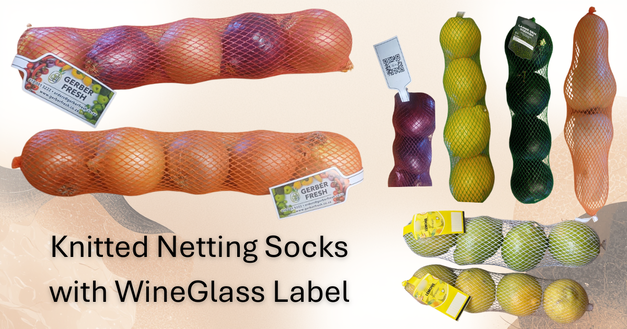
With citrus season approaching, planning is already underway. Gerber Fresh supplies swing tags for pockets of oranges and other citrus destined for the domestic market, as well as citrus juicing machines to major supermarket groups.
 © Gerber Fresh
Investment in processing efficiency
Despite cautious spending, investment in efficiency remains a priority for many processors. Gerber Fresh recently sold its first TS170 Belt Slicer to a butternut processor — a milestone for the company, they say. "The machine enables high-volume slicing within seconds," Van der Nest says, "offering durability and efficiency that deliver strong returns on investment for operations processing large daily volumes."
Irving highlights the importance of food-grade engineering in such equipment. "In high-care food environments, machines must be 100% stainless steel. That standard comes at a cost, but it ensures compliance, safety, and longevity."
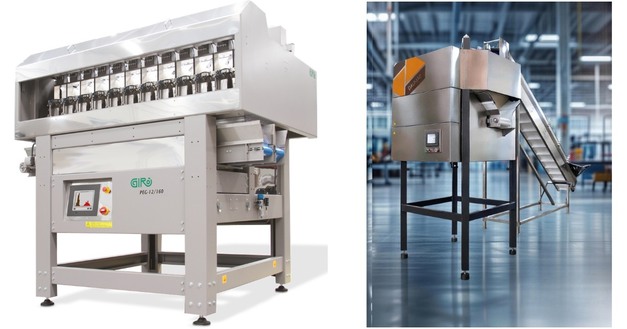
Another innovation generating interest is the PEG-12 linear weigher. Designed for speed and precision, it can achieve up to 60 weights per minute on a standard one-kilogram line and handles products up to 150mm in diameter. The system integrates seamlessly with automated bagging and clipping equipment, offering packhouses improved throughput.
While the PA-25 bucket weigher has been the company's best-selling model locally, the PEG-12 represents what Van der Nest describes as "a significant step forward in automation for high-volume pack lines."
 © Gerber Fresh
Left, the PEG-12 linear weigher and right, the PA-25 bucket weigher
Gerber Fresh positions itself as a niche supplier offering end-to-end support to packhouses and processors. Beyond supplying packaging materials and machinery, the company prioritises long-term partnerships.
"Our philosophy is simple: if we don't stock it, we will source it," Van der Nest says. "We aim to support our customers from the beginning to the end of their process. As our customers evolve, we evolve with them, and our basket offering grows. That's why we even have coffee machines!"
This customer-centric culture is reflected internally as well, they say, with an average staff tenure of 15 years — ranging from 7 to 28 years — reinforcing the company's long-term commitment to relationships.
Expanding branding possibilities
On the packaging front, innovation is also taking place in labelling. A newer concept - the clip-to-clip label - extends across the full length of a net bag and is secured at both ends. This format increases branding space and product visibility, and in certain sizes can double as a handle on a two-kilogram pack. Although widely used internationally, it has yet to gain traction in South Africa.
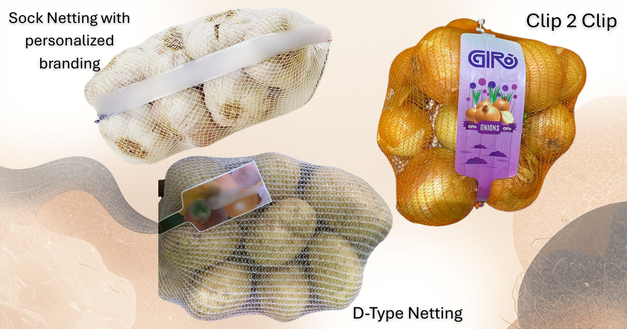 © Gerber FreshThe clip-to-clip label increases branding space and product visibility
Most of Gerber Fresh's packaging materials are sourced from Spain, requiring forward planning of three to six months to manage seasonal peaks in onion and potato production across various regions. December demand adds further complexity, as retailers often run high-volume promotions with limited lead time.
The company's relationship with Spanish manufacturer Giro spans three decades. Gerber Fresh played a key role in introducing Giro's netting bags to the South African market — a format the team strongly believes aligns with future sustainability goals.
"We see net packaging as a cost-effective, lower carbon alternative to poly bags," Irving notes. "It offers better breathability for fresh produce, is widely recyclable, and reduces overall plastic usage. Globally, there's a clear shift back towards new net formats."
In a challenging economic climate, the company aims to balance innovation with pragmatism. "For Gerber Fresh, the path forward lies in balancing innovation with affordability," Joyce observes, "offering solutions that reduce plastic usage, manage shrinkage and support operational efficiency without adding undue cost to the supply chain, or additional pressure on consumers."
 Visit Gerber Fresh on: Facebook | LinkedIn | Instagram | TikTok
For more information:
Gerber Fresh
Tel: +27 10 001 5222
Email: [email protected]
https://gerberfresh.co.za/