A delegation from Bagu, a Castellón exporter specializing in clementines and mandarins, will travel to Berlin to exhibit at Fruit Logistica (February 4-6, Hall 11.2, stand B-01). There, they will present a comprehensive technical report on their XLO Clementine, which is poised to revolutionize the start of the season thanks to its early harvest and its genuine potential to compete in quality and freshness with mandarins from the Southern Hemisphere arriving at that time.
They will also showcase a second study by the Valencian Institute for Agricultural Research (IVIA), which confirms that the new variety remains in good condition after up to 25 days refrigerated at the cold treatment temperature. This makes it especially suitable for export to overseas markets that require such low-temperature treatment.
The first analysis cited shows results from a farm owned by this company in Cartaya (Huelva), where the variety was grafted in 2022. As previously announced, the fruit differs in size and matures early—harvesting begins in the second half of September, two weeks before Oronules. Perhaps most surprising is its early entry into production in this third year, yielding 39.4 tons per hectare (t/ha). This is a record figure, surpassing other early clementines, which suggests high yields when the XLO trees reach 7 to 8 years of age.
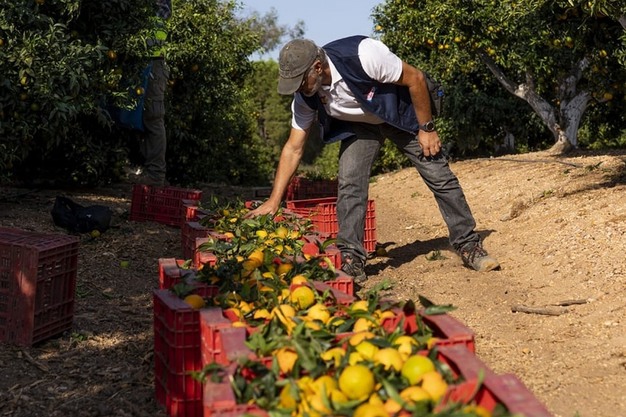 © BaguThe study recommends producers prioritize harvesting and marketing the XLO with leaves, and without them when the market requires it.
Aside from its size, early maturity, productivity, and good conservation, the study highlights a fifth commercial benefit: the improved freshness provided by its unique conditions for marketing with leaves, which appeals to premium consumers. It states, "this approach allows us to compete in a different segment from imported fruit, where factors like freshness perception, origin, flavor, and visual quality are key for accessing higher-value markets." The commercial strategy for XLO could include both leafy and non-leafy varieties. According to the proposal, its consistent production, effective tree retention, and stable internal quality would give stores greater flexibility by enabling them to adjust volumes and formats, promote marketing with leaves, and, when market conditions demand, market without them without sacrificing quality.
Unlike other early-season clementines, XLO maintains good condition after packing, with stable juice, solids, and acidity, resulting in a very good taste. The study shows this new Clementine's harvest timing does not compromise internal quality, as its physiological maturity matches its external earliness.
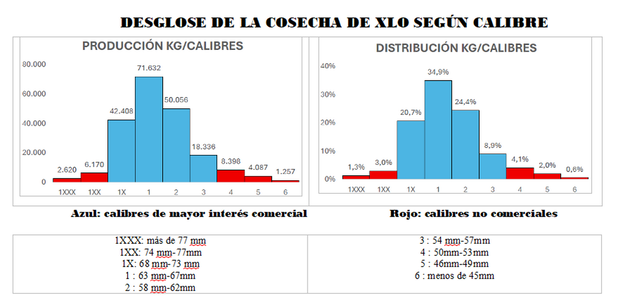
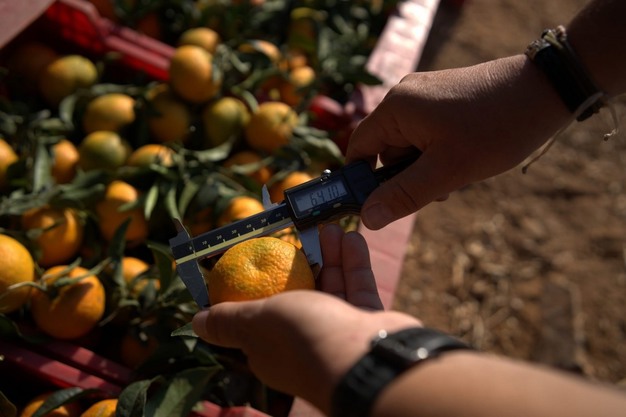 © Bagu Eighty-six percent of the XLO crop consists of the most commercially appealing sizes (between 54 and 73 mm).
The 43-page study explains why the new spontaneous Oronules mutation is commercially valuable from an agronomic view. A key feature is XLO producing "bell flowers" in spring—large, single blossoms with high fruit set, a rare trait among many clementines. The report states: "The bell-shaped flower generates more individualized fruit with better distribution in the canopy, reducing cluster formation and preventing excessive fruit concentration. This enhances size and reduces manual thinning." Additionally, the absence of multi-budding during sprouting makes handling easier and extends the plant's productive lifespan.
XLO grows on strong, thornless trees, which makes harvesting easier. This trait not only supports a higher fruit load but also provides growers with more options for planting or grafting onto rootstocks that are less vegetatively vigorous, as recommended in this work: Citrange Troyer and Carrizo, C-35, and Forner Alcaide Nº 5. These factors collectively justify its XL size designation, with the 'O' referencing the original variety, Oronules.
The XLO can help boost profitability due to the sizes it produces. Data from gauging and harvesting show that the crop mainly includes sizes 1X, 1, 2, and 3 (54-73 mm), which make up 89% of the harvest and are the most commercially valuable sizes. Very large sizes are rare, and very small sizes are minimal.
At Bagu's request, IVIA conducted a second study on XLO's cold tolerance for markets like the USA, China, India, and Korea. Despite prolonged cold treatment at 1°C for 25 days, results showed that XLO is well-suited to cold storage and transport, with no physiological changes or negative effects on fruit quality.
 © Bagu
 © BaguFor more information:
Bagu
Plaza el Pla 3,
12530 Burriana, Castellón. Spain
Tel:+34 964 51 25 00
Email: [email protected]
www.baguclementinas.es