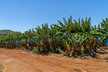
The global banana industry has long been threatened by Fusarium wilt. Traditional breeding is challenging because most banana cultivars are sterile triploids. The Taiwan Banana Research Institute (TBRI) has successfully developed multiple Fusarium wilt–resistant lines through mutation-mediated breeding, providing a critical line of defense for the global banana industry. A cross-laboratory team led by Associate Research Fellow Ho-Ming Chen of the Agricultural Biotechnology Research Center (ABRC), Academia Sinica, in collaboration with National Taiwan University and the TBRI, employed genomic, transcriptomic, and functional analyses to comprehensively elucidate the key differences between these disease-resistant lines and their susceptible parental cultivar, 'Pei-Chiao'.
The study revealed that multiple disease-resistant Taiwan banana lines harbor large-scale chromosomal deletions, resulting in reduced copy numbers of genes encoding autoinhibited Ca²⁺-ATPases, which act as negative regulators of plant immunity. When the expression of these genes was suppressed in the susceptible cultivar 'Pei-Chiao' using gene-silencing techniques, salicylic acid–mediated immune responses were markedly enhanced, and resistance to Fusarium wilt was significantly improved. These findings demonstrate the critical role of chromosomal structural variation in banana mutation-mediated breeding and provide actionable genomic targets for precision breeding of disease resistance.
This research was supported by the "Innovative Translational Agricultural Research Program" and "Grand Challenge Program" from Academia Sinica. The first author is Puyam Tondonba Singh, a Ph.D. student at the ABRC and the Institute of Biotechnology, National Taiwan University. The results were published in the Proceedings of the National Academy of Sciences (PNAS) on November 24, 2025.
For more information: www.sinica.edu.tw