© Continental FreshAt this time of year, U.S. mango supply is primarily coming from South America. Ecuador is currently winding down its mango season, which will conclude around the end of December. Total Ecuadorian shipments are slightly below last year's level – roughly 10–15 percent lower year-over-year and the country is projected to export 12.7M cases to the U.S. market this season vs. 14.7M last season. Fruit quality from Ecuador has been great this year.
"We've been really pleased with the quality out of Ecuador this year," said Alejandro Guerrero, Director of Grower Relations at Continental Fresh. "Clean fruit, great sizing, and strong brix levels made it a season to be proud of — a win for growers and consumers alike." As Ecuador wraps up, it remains a key supplier through the holidays before Peru fully takes over.
Peru's delayed start and smaller crop
Peru's mango season has been slow to ramp up. Unusual weather patterns have delayed the crop; cooler temperatures, erratic flowering, work stoppages have all impacted supplies. Compounding this, the mango trees are in an alternate bearing cycle following last year's heavy production, which is expected to reduce Peru's export volume by about 25–30 percent year-over-year. Peru is projected to export 21M cases to the U.S. market this season vs. 29M that were imported last season.
Early shipments out of Peru have shown fruit with lower maturity, a result of the delays – some mangoes have been harvested a bit earlier than ideal. However, eating quality is anticipated to improve as the Peruvian season reaches its peak. The main variety (Kent) should color up and sweeten in the coming weeks. Peru's harvest will build through January, with volumes expected to climb steadily and peak by mid-to-late January.
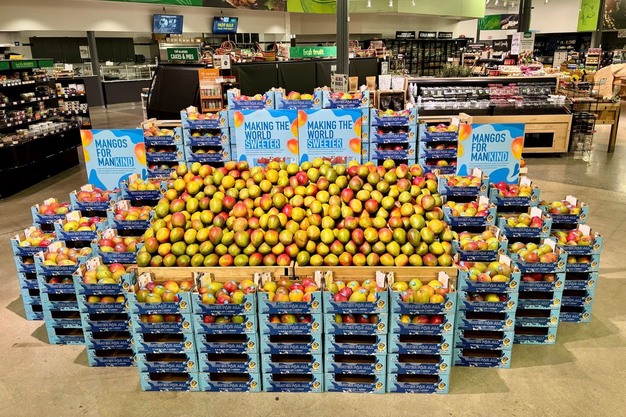
"Even with a late start, there's a lot of excitement among our growers in Peru," Guerrero shared. "We could see another strong finish — Kents from Peru have a loyal following for a reason. Last season, Peruvian Kents were some of the best tasting mangoes of the year and were flying off the shelves. We are hoping for a repeat performance this season."
 © Continental Fresh
Demand and steady pricing
Spot market demand for mangos has been moderate in recent weeks. Higher prices and colder winter weather in many U.S. regions tend to temper consumer appetite for tropical fruit. Additionally, general economic jitters have made buyers a bit cautious. The timing of holidays this year – with Christmas and New Year's falling mid-week – has and will continue to disrupt the usual logistics and retail promotion schedules. Many retailers focused on moving contracted fruit for their programs, and there's been minimal push for big mango promotions in December.
Most of the incoming volume is tied up in retail contracts or programs, so the spot market activity is limited. In fact, the mango business at this stage is largely program-driven – leaving little surplus for open market sales.
Tight supply outlook into January
Looking ahead at the next few weeks, mango supply is expected to remain tight. With Ecuador finishing and Peru still ramping up, nationwide mango arrivals will be lower than usual for about the next three to four weeks. "This gap in supply means availability will be snug – we're closely managing inventories to meet our customers' needs," commented Guerrero. By mid-January, as Peru hits its stride, volumes should increase and relieve the pressure. Peru is projected to reach full production in the second half of January, coinciding with its seasonal peak. "Until then, we'll navigate a lean period."
Continental Fresh advises its partners to plan conservatively for early January and focus promotions on mid-January through mid-February. The company will continue working closely with its growers and customers to ensure consistent supply and top quality. "We're confident that as the Peruvian season peaks and additional fruit comes on stream, the mango market will regain momentum heading into late January and the remainder of winter."
 For more information:
Alejandro Guerrero
Director of Grower Relations
Continental Fresh
[email protected]
www.continentalfresh.com