Almond growers in Australia are expected to benefit from the development of orchard systems designed specifically for local growing conditions. The work aims to improve productivity, resource efficiency, and long-term resilience in almond production.
The project is funded by Hort Innovation and builds on five years of earlier research conducted across several initiatives. It will be developed in consultation with industry and reflects growing interest in self-pollinating almond varieties, particularly in orchards dominated by Nonpareil, the country's most widely planted variety.
According to Hort Innovation, the project is intended to ensure that orchard systems remain aligned with the practical needs of Australian growers. The focus is on adapting orchard design to local environments, with the intention of improving yields while reducing inefficiencies in water, nutrient, and labour use.
 © Hort Innovation
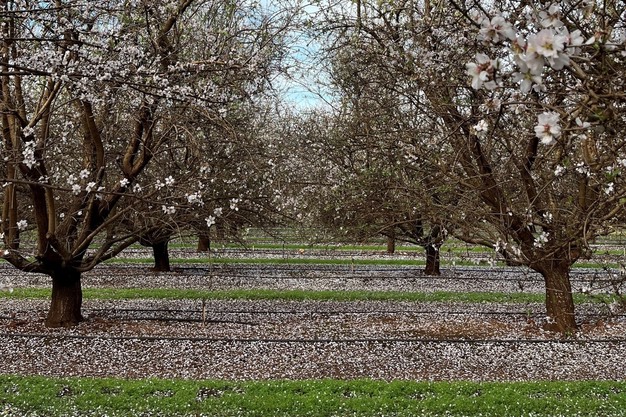
Almond production in Australia has traditionally followed orchard models developed in California, characterised by relatively low tree densities and large canopies. While well established, this system can create challenges under Australian conditions, including higher water requirements, slower yield development in young orchards, and limitations linked to canopy size and structure.
Recent research indicates that traditional layouts with fewer trees per hectare may not always be the most efficient option. Findings suggest that different almond varieties respond differently to planting density. Some perform better in higher-density systems, while others require more space. Combining different tree types and planting patterns within a single orchard may allow growers to increase overall productivity and adapt more effectively to changing conditions over time.
Field trials will be conducted at the Almond Centre of Excellence and at a commercial orchard with heavier soils. These trials will examine how different almond varieties respond to variations in irrigation, nutrient management, and orchard design. The results are expected to contribute to the development of practical guidelines that growers can use when assessing changes to their orchard systems.
The project is being delivered by the South Australian Research and Development Institute through Flinders University, in collaboration with Plant & Food Research Australia Pty Ltd. The partners will draw on existing research to assess orchard configurations that are better suited to Australian production environments and industry requirements.
Researchers involved in the project note that Australian almond growers operate under conditions that differ significantly from those in major producing regions such as California and Spain, particularly in terms of climate, labour availability, and cost structures. Testing alternative orchard layouts and management strategies is intended to provide evidence-based options that reflect these differences.
The initiative is funded through the almond research and development levy, with additional contributions from the Australian Government, SARDI, and PFR.
 © Hort InnovationFor more information:
Shannon O'Mara
Hort Innovation
Tel: +61 (0) 427 142 537
Email: [email protected]
www.horticulture.com.au