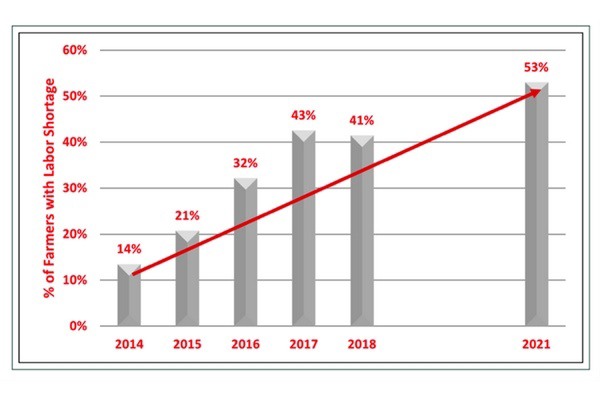
U.S. agriculture has faced persistent labor shortages over the past two decades, driven by lower immigration, rising education levels, competition from non-farm sectors, and an aging foreign-born workforce. Although farm wages have increased faster than wages in much of the broader economy, this has not been enough to attract sufficient domestic workers into seasonal and physically demanding farm jobs.
As a result, the H-2A visa program has become a central component of the agricultural labor supply. The program allows U.S. farm employers to hire seasonal foreign workers when domestic labor is unavailable. Michigan reflects this national trend, particularly in labor-intensive fruit and vegetable production such as apples, blueberries, cucumbers, squash, and asparagus. In 2024, Michigan farms employed around 15,000 H-2A workers.
 © Michigan State University
The H-2A program, established in 1986, permits temporary employment of foreign workers in seasonal agricultural roles, generally for up to 10 months. Employers must demonstrate a lack of domestic labor, provide free housing, cover transportation costs, and pay at least the Adverse Effect Wage Rate, a minimum wage designed to avoid downward pressure on U.S. farm wages. When housing, transportation, and administrative costs are included, total H-2A employment costs are estimated to be 20% to 50% higher than hiring domestic workers.
Use of the program has expanded rapidly in Michigan, from fewer than 1,000 certified H-2A positions in fiscal year 2008 to more than 15,000 in fiscal year 2024. Employment is concentrated in counties with large fruit and vegetable industries, including Oceana, Kent, Ottawa, Berrien, and Monroe.
Until 2025, the Adverse Effect Wage Rate was based on the USDA Farm Labor Survey. After the survey was discontinued in August 2025, the Department of Labor introduced a new methodology effective October 2, 2025. Under the revised system, AEWRs are calculated using Occupational Employment and Wage Statistics data and are weighted across five farm-related occupations.
The new rule introduced two wage tiers based on experience. Skill Level I applies to entry-level jobs and is set at the 17th percentile wage. Skill Level II applies to experienced positions and is set at the 50th percentile wage. The rule also introduced an Adverse Compensation Adjustment to account for employer-provided housing, typically reducing the AEWR by US$1 to US$3 per hour.
For Michigan in 2026, the OEWS-based AEWRs are US$13.78 per hour for Skill Level I and US$17.47 for Skill Level II. After applying the housing adjustment, the Skill Level I rate falls below the state minimum wage of US$13.73, making the minimum wage binding for entry-level positions. Compared with the 2025 AEWR of US$18.15, estimated employer wage costs in Michigan are projected to decline by 11% to 24% in 2026.
The revised methodology may support further expansion of H-2A employment, although legal challenges and employer wage practices could influence implementation over time.
For more information:
Michigan State University
Tel: +1 517 355 1855
Email: [email protected]
www.canr.msu.edu