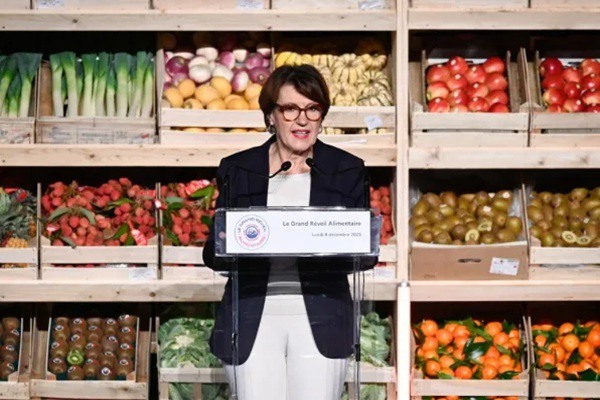
"The agricultural war is brewing," claimed Annie Genevard on December 8th at the opening of the Conferences on Food Sovereignty, calling for a "Great Awakening." The aim is to draw up a 10-year production plan for France to "regain its food sovereignty." The farming unions, for the most part, are denouncing this as nothing more than a publicity stunt. The government has sought to involve the public in the process by setting up a consultation on the Agora platform until December 31st.
 © Thomas Hubert
Conferences provided for in the March 2025 Agricultural Policy Law
"The war on agriculture is threatening more and more every day, and it is time to act," declared the French Minister of Agriculture, referring to current world events. "The war between armies brings with it a war in the fields." Customs duties and taxes are rising while production conditions are getting tougher:" unprecedented drought, violent floods, water stress, new pests. [...] This is why all the major powers are already including their agriculture in global, proactive strategies," taking the example of the USA, "which is increasing production subsidies and consolidating its leadership in corn."
While France's agricultural trade balance could be in deficit by 2025, for the first time in almost 50 years, the Minister listed the "fundamental shifts" threatening French agriculture, led by "the erosion of our production factors. Over the next 10 years, one in 2 farm workers will retire." There is also price volatility, coupled with a price war that is "inevitably leading to a deterioration in producer remuneration." Added to this is the burden of structurally high costs (inputs, energy, climate adaptation, regulatory standards) "which are undermining farm incomes." And finally, climate change "will considerably change the face of French agriculture." All this pressure "can be seen in one indicator: our plates! 1 in 2 fruits and vegetables consumed in France is imported, 1 in 2 chickens, 60% of the honey we consume, as well as 50% of sheepmeat, 80% of fish products."
Faced with these facts, the government has launched the Conferences on Food Sovereignty - provided for in the Agricultural Policy Law (LOA) passed in March 2025 - which are intended to "promote collective reflection, leading to the redesign of our landscapes and our production map over the next 10 years."
Sector-based working groups
These conferences, which will take place over several months, will bring together the entire food chain: farmers, processors, distributors, professional and inter-professional organizations, as well as institutional partners. They will take place at two levels - national and regional - and will be organized sector by sector: arable crops, beef and sheep farming, white meats, winegrowing, fruit and vegetables, fisheries and aquaculture. Under the aegis of FranceAgriMer, more than 200 professionals will be mobilized in "multi-sector" working groups charged with drawing up an inventory of the current situation and "establishing a strategy for building coherent, viable production over the next ten years." At the regional level, the prefects will be in charge of implementing the scheme. An initial progress report is expected in February, at the next International Agricultural Show, when the first conclusions will be presented. The government has entrusted Ludovic Spiers, former CEO of Agrial, with the task of overall coordination. The whole process is due to culminate in the summer of 2026, with a major national conference to "mark the official launch of a food sovereignty strategy."
FNSEA will be taking part in the work, but not in a "communication operation"
In a press release, the majority farmers' union FNSEA said that it was "reaffirming its commitment to participating fully in the working groups, where it will put forward the voice of farmers and its vision of sovereignty based on production, competitiveness and territorial roots." The union declared that it was "astonished at the form given to the launch event announced at Rungis. This event, organized at the beginning of the week, when agricultural leaders are on their farms or mobilized by their local commitments, is more akin to a communication operation than a time for shared work. For all these reasons, and in consultation with other professional farming organizations, FNSEA will not be taking part in this communication operation."
"A total disregard for the profession," according to Coordination Rurale
Coordination Rurale, on the other hand, has announced that it would not be taking part in the working groups, saying that this "Great Food Awakening" is a total disregard for the profession. "At a time when there is talk of a possible war, we have no food stocks, and we would not have the means to be self-sufficient. After the great debates and repetitive meetings, which were useless because they were not followed by any concrete reforms, today's 'great food awakening' shows total contempt for the profession! Now is not the time for discussions, but for a political awakening to bring about complete structural reform." The union is urgently calling for "the suspension of the regulatory framework and the introduction of protectionist measures to save farmers with energy, tax, and social shields."
"We cannot take part in this masquerade of the 'Great Food Awakening'"
Confédération Paysanne had also indicated that it would not be taking part in "the high mass on December 8th." "The forced passage of the Duplomb law is emblematic of this government's trampling of the very essence of food sovereignty," according to a press release. Confédération Paysanne expects "concrete action," starting with France saying no to the EU-Mercosur agreement. "Instead of parading around Rungis, the Minister of Agriculture should be flying to Bucharest to convince Romania (about Mercosur), which would give her a blocking minority as things stand. We are at her disposal to pay for her plane ticket if necessary."