Global pear markets are moving through a mixed season, with some countries reporting improved volumes and quality while others face reduced yields, shifting prices, and changing demand dynamics.
Italy reports lower pear production due to reduced yields and climate-related challenges, while Dutch traders describe a season marked by lower prices and concerns over fruit firmness. France has revised its pear harvest upward, showing improved volumes and quality, and Germany continues to rely heavily on Italian supply as availability tightens.
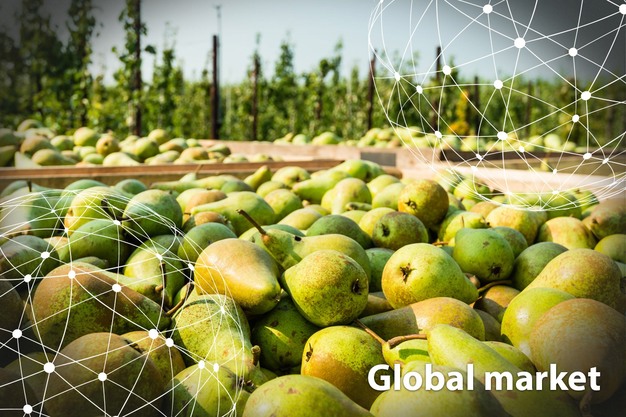 © Viola van den Hoven-Katsman | FreshPlaza.com
Spain expects a 10.5% increase in pear volume, though still below the long-term average, and Greece faces a crop reduced by almost half following spring frosts. North American volumes have rebounded strongly across key varieties, with particularly sharp increases in specialty pears, and South Africa notes easing prices ahead of the new harvest as export opportunities continue to expand. India's pear market has moved through a difficult 2025 season, shaped by shifting trade flows and a prolonged oversupply that pressured prices throughout the year.
Italy: Production drops despite stable acreage trend
It is well known that Italy's pear sector has experienced one of the most challenging periods in its recent history due to production difficulties closely linked to climate change. In 2025, the acreage declined compared to the previous year, but the reduction was more in line with normal turnover. The number of orchard removals has been much lower than in previous years. According to CSO Italy data, the total production area was approximately 19,600 hectares nationwide this year, with Emilia-Romagna maintaining its leading position with 10,500 hectares. In both cases, the decrease amounts to 7 per cent. Added to this contraction is a drop in average yields per hectare, estimated at 20 per cent less than in the 2024 season, bringing total production to approximately 293,000 tons.
After a promising bloom, climate instability and spring rains caused significant fruit drop. Additionally, during the summer, growers encountered phytosanitary issues such as brown spot and a resurgence of brown marmorated stink bugs, particularly in northern regions. Despite the lower volumes, the proportion of Class I quality pears has increased, and waste has decreased. Summer varieties are larger than last season's, while fall-winter varieties are stable or slightly smaller than in the 2024/25 season.
A major trader from northern Italy states: "Currently, prices are fairly strong, but sales are slow in terms of volume, which is in line with the low consumption of all fruits at this time of year. Sales should pick up in the week leading up to Christmas. In past years, many imported pears, also from Northern Europe, appeared on supermarket shelves. However, this year, domestic production should be sufficient to meet demand."
According to YouGov data, 14.7 million Italian households purchase pears. The average purchase frequency is seven times per year, and the average spending and quantity per purchase remain stable. Consumer preference continues to lean toward variable-weight products (50 per cent). A noteworthy trend is emerging in the organic sector: more households are buying organic pears than other fruits and vegetables. The growing share of an increasingly older population with greater awareness of wellness and sustainability may be one reason behind this positive trend.
Netherlands: Lower prices and quality-driven risks
"Pear sales are going reasonably well at the moment. Sufficient volume is moving, but prices this season are significantly lower than last year. This price pressure marks the mood in the market and calls for extra sharpness in the chain," says a Dutch fruit trader. "Interestingly, the flavour of pears is exceptionally good this year, thanks to the high sugars. At the same time, those same sugars have an effect on shelf life and firmness. Throughout, the pears are softer and more delicate than we would like, and this requires a lot of attention in sorting, packing, and delivery."
"In practice, we notice that there are already batches that would have been better processed a month earlier. The low prices tempt us to hold on to fruit longer in the hope of a better market. But this season, quality does not allow that as much. When buyers become uncertain about the stability of the product, they become more cautious. This inhibits the market and ultimately leads to more fruit being left lying around that really should already have been processed. Buyer confidence is crucial; without it, the chain clogs up."
Belgium: Pear market moving smoothly, though prices could be better
The pear market is running at full speed, says a Belgian trader. "Conference remains the most important variety, and a great deal has been cleared in recent weeks. Sales are significantly higher than last year, which is necessary given the larger stock. Last week alone, more than five million kilos were sold, compared to around three million kilos per week last year."
Demand is currently coming from all sides. "Italy, Spain and the UK are buying well, Germany is loading strongly, and China is also purchasing large volumes. Besides Conference, other varieties are even selling faster. For Doyenné, we're already seeing free volumes approach their end, and supply will drop sharply around mid-December. Blushed pears such as Fred, Sweet Sensation and Qtee have also entered the market and are performing well both domestically and abroad."
Despite the strong sales, he does not expect major price increases. "Current price levels will likely hold until spring. Some upward price movement may be possible from March onwards, provided stocks in Belgium and the Netherlands have been sufficiently reduced by then. Quality is also remarkably good this year, thanks to the absence of hail damage. Only late-harvested batches suffered more losses due to the warm September weather, but most of that has since been sorted out."
France: Forecasted pear harvest revised upward
The French pear industry was expecting a decent season, but it has turned out to be better than anticipated. Forecasts updated in late October and early November predict a harvest of around 150,000 tons, compared to the 140,000 tons forecast by PrognosFruit last August. The harvest is also notable for its quality. Both visually and in terms of taste, the fruit is of excellent quality this year, with particularly high sugar levels.
Consumption remains slightly slow for the time being due to a late start to the season. At the end of the summer, competition from stone fruits, which were still tasty, combined with weather conditions that favored their consumption over that of pome fruits, delayed the start of the pear season. Although initial sales were somewhat sluggish, the season then gradually picked up, supported by the regular succession of varieties, good production conditions, and high quality.
The diversification of varieties in French orchards helps to extend the availability of French pears on the domestic market, which is now supplied beyond the end of January. Despite some traditional fluctuations linked to competing offers, prices remain stable and balanced, maintaining a satisfactory economic environment for the sector. Overall, the season is looking fairly positive at present.
Germany: Italian pears dominate as supply tightens
Italian batches, primarily Abate Fetel, Santa Maria, and Williams Christ, dominated the market. The total supply was slightly decreasing. Nevertheless, traders often insisted on the previously high prices, which noticeably slowed down sales. Turkey mainly supplied Santa Maria, complemented by Deveci.
Domestic supply consisted primarily of Xenia, Conference, and Alexander Lucas, but all of these lost relevance due to the late season. Dutch supplies also declined. Prices fluctuated, but no clear trend was visible. In the long term, prices for Abate Fetel, by far the largest variety in Italian pear cultivation, have tended to rise. This is primarily due to the massive yield losses of recent years, a trader confirms.
Spain: Pear volume up 10.5% year on year
Spanish pear production will reach more than 246,600 tons, an increase of 10.5% compared to last year, although volumes remain 16.6% below the historical average. The Conference variety will account for slightly more than half of the total, with 125,897 tons, representing a 25% increase compared to the previous year. Other varieties show mixed results, including Ercolini-Coscia at 26,650 tons (-21.4%), Blanquilla at 25,280 tons (-10.9%), and Williams at 25,630 tons, which will surpass Blanquilla in volume for the first time.
The pear market remains stable, with no major price fluctuations and all values above the average. In the fields, pear varieties remain stable, with slight increases. Prices at the packing house last week were mixed, with a slight decrease in Blanquilla (-2.9%). In regional markets, the Conference pear recorded a notable drop in Zaragoza (-10.6%), although it remains above the average, with stability in other markets.
Greece: Frost cuts crop by nearly half
This Greek pear season, the sector is facing the consequences of the spring frosts. The very first blossoms of the pear trees were affected, resulting in a volume drop of nearly 50 per cent for all varieties compared to 2024. Demand for pears has been picking up in November. The biggest market for Greek pears is the Israeli market, to which both Santa Maria and Blanquilla pears are exported. Demand in Israel is currently very high, as local quantities have been much lower this season compared to previous years. Around late February or early March is the period when pear sales typically start climbing.
North America: Volumes rebound across key varieties
Following the short crop of domestic pears last season, this year the industry's pear volume has made a substantial recovery. While both conventional and organic pears are up, organic is contributing a significant share of that growth.
Promotable volumes are expected across all major varieties. In the specialty segment, Forelle and Comice volumes have doubled, while Seckel output has reached nearly three times the 2024 level. Good quality and ideal sizing for both bulk displays and bagged promotions are expected for Bartlett, Anjou, Bosc, and Red Anjou pears. Specialty Gem pears also continue to grow annually.
Pear demand is steady heading into the holiday season, and momentum is expected to continue building over the next several weeks. Retailers are positioned to run consistent ads and build displays that support larger basket sizes. That means steady-to-strong movement is anticipated in the coming weeks, particularly for core varieties like Bartlett, Anjou, and Bosc, along with growing interest in specialty and snacking pears as retailers introduce more variety into their displays.
However, education remains an important factor in pear movement, particularly information that helps reduce consumer confusion about ripeness and readiness.
South Africa: Prices ease as new season approaches
In South Africa, the average price of a pear is almost R10 (€0.58) per kilogram, with small Packhams and Forelles being packed from the Controlled Atmosphere rooms where they have been held for ten months or longer. Compared to the two previous years, the price is lower. A fine topfruit crop is expected after a dry spring, which boosts pollination and fruit set, and the harvest will commence roughly two months from now with early Williams Bon Chretien.
Export opportunities for South African pears have been on the rise. In India, a trader said at a fresh produce conference that South Africa has completely taken the pear market and become synonymous with pears. Russia is another major receiver where the South African fruit trade has seen a significant uptick, while China is another possibility the industry did not have in recent years.
India: Chinese supply reshapes pear market
India's pear market experienced an unusually slow 2025 season despite sufficient supply from major origins. Consumer demand lagged as Chinese pears entered the Middle East, Gulf, and Russia at competitive prices, absorbing regional demand. As a result, South African exporters redirected surplus CA storage pears to India, with 200 containers loaded in October alone, creating a prolonged oversupply between the South African and South American seasons. Market prices fell 25 per cent compared to last year.
The Indian pear calendar begins in January with South Africa's Rosemary variety, which has a narrow marketing window, followed by premium Packham's Triumph, Forelle, and Vermont Beauty varieties through July via Controlled Atmosphere storage. Indian pears fill the July gap for 45 to 60 days but face challenges due to lower visual quality and shorter shelf life. November to December typically features Argentinian Packham's, late South African CA fruit, Chilean Forelle, and the USA's Anjou, alongside the domestic Maafi variety. Importers remain optimistic that the market will stabilise next season with better supply alignment.
Next Topic: Papaya