The Chilean cherry season is now transitioning from its initial air-freight phase into the period when volumes start to build, but the market has opened with a tone of caution. The start of the campaign has been notably different from previous years, shaped by early-season weather challenges, softer demand, and shifting quality expectations in China.
 © D-Quality
Early arrivals meet a softer market
D-Quality Survey BV, an independent surveyor company that performs QC inspections, creates market reports, and analyzes global quality and sales data to help clients continuously improve produce shipments. According to Julio Ruiz-Tagle, the Asia & America Manager at D-Quality Survey, "the Chilean cherry season is gaining momentum, but the opening has not been as optimistic as in previous years." He describes an early market affected by oversupply, inconsistent firmness in some early fruit, and varieties that are still building recognition among buyers. Cold weather and rainfall in both Guangzhou and Shanghai further reduced traffic in the wholesale markets, slowing sales at a moment when early enthusiasm is usually strongest.
However, Julio notes that the market has shown clear improvement in recent days. "Buyer activity has increased, sales are moving more quickly, and the market has reacted positively to slight improvements in quality and higher volumes," he says, "in particular, Santina is performing well, showing stronger firmness and lower defect rates compared with other early varieties."
 © D-Quality
Volume outlook adjusted downward
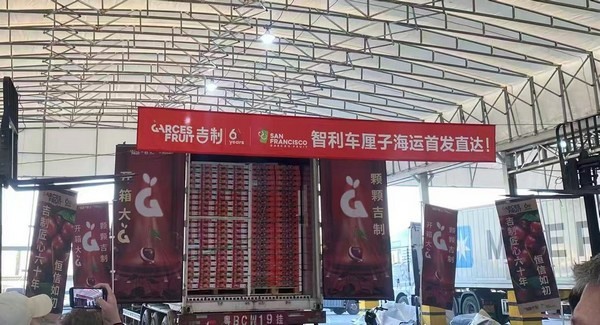
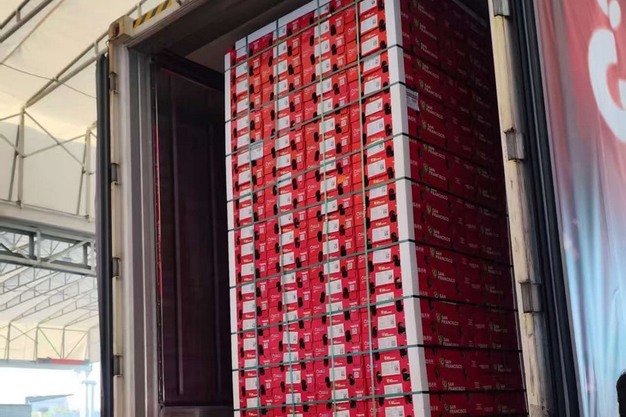
Exports began with early air shipments about a month ago. The first major maritime arrivals are scheduled for early December, entering the crucial sales window that runs through Western New Year and peaks around Chinese New Year. "Depending on late varieties and market absorption capacity, most seasons wrap up by late February or early March," Julio adds.
The season began with ambitious projections. Early estimates suggested that Chile could reach roughly 134 million 5-kg-equivalent boxes. Julio explains that unpredictable weather and quality variability have led to a more conservative outlook. "Based on the most recent technical observations, we expect the season to finish closer to 110–120 million boxes, very similar to last year."
 © D-Quality
Market reaction to early varieties
The first air shipments included varieties such as Nimba, Sweet Aryana (¥270–¥300/kg), Black Rock (¥290–¥300/kg), Pacific Red, Meda Rex and Royal Dawn (¥250 - ¥260/kg). "The market reaction has been cautious," Julio says, noting that early prices have been lower and demand softer than what exporters saw in previous years. As Santina (¥260 - ¥340/kg) and Royal Dawn began arriving with stronger quality, market activity improved, but prices remain under downward pressure as supply increases week by week. The size 2JD cherries are currently selling at around ¥100–¥110/kg.
 © D-Quality
Julio remains cautiously optimistic. He does not expect total volume to exceed last year's crop and notes encouraging consistency in the fruit now being observed in orchards and packing houses. "Cherries will always be a premium product. There will always be demand for high-quality Chilean cherries. The challenge is expanding the consumer base."
Prices may remain under pressure in the near term, but he predicts improvement as higher-quality fruit begins to dominate arrivals and as Chinese New Year approaches. "It is still early to make definitive predictions," he adds.
 © D-Quality
For more information:
Julio Ruiz-Tagle
D-Quality Survey BV
Phone: +56992500021 (Chile Phone) / +8613229312404 (China Phone/Whatsapp/Wechat)
[email protected]
www.dqualitysurvey.com