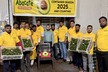
In April 2025, the Mexican Avocado Institute launched the "Route to Sustainability" (Ruta hacia la Sostenibilidad), a strategic initiative aimed at strengthening environmental and social responsibility in the avocado export sector. This effort aligns with a federal government program introduced earlier that promotes deforestation-free agricultural exports and formal labor standards.
Mexico, the world's largest avocado producer, accounts for 26.6% of the globally harvested avocado area. Production and exports have surged in recent years, with the USDA forecasting a 3% increase in avocado production in 2025 compared to 2024. The United States continues to be the primary export destination, receiving 80% of shipments, followed by Canada at 7% and Japan at 3%. Meanwhile, domestic consumption rose by nearly 10% in 2024 to reach 12.3 kilograms per capita.
However, the industry's expansion has raised environmental concerns, especially regarding deforestation, sometimes linked to illegal land use and criminal involvement. In response, the Netherlands Embassy in Mexico conducted a 2023 study on the environmental impacts of avocado production and trade with Europe. This has led to a collaboration between the Embassy and the Dutch "Partners for Water" initiative, which will launch a watershed restoration project, La Laguna de Zapotlán, in Jalisco in August 2025.
The "Route to Sustainability" strategy focuses on four key areas. The water program aims to ensure sustainable water resource management across all production sites by 2026, including efforts such as distributing 690,000 pine seedlings. The biodiversity component promotes ecosystem restoration and the use of integrated pest management. Climate goals include reducing emissions and achieving net-zero carbon output by 2035. The deforestation pledge commits to zero net deforestation by 2035, supported by cooperation with government authorities and forest baseline studies to identify critical areas for protection.
The Association of Avocado Exporting Producers and Packers of Mexico (APEAM) has supported sustainability since 2011 and has planted over 3.6 million trees in reforestation projects. The "Route to Sustainability" consolidates these efforts under five interlinked programs: Corporate Governance for Sustainability, Sustainable Orchards, Sustainable Packing Plants, Sustainable Distribution and Marketing, and Biodiversity, Forest, and Watershed Restoration. Together, these form a comprehensive sustainability framework for the avocado supply chain.
Early in 2025, the Mexican government also introduced a broader agricultural export compliance program, beginning with the avocado sector. The program aims to ensure that exports comply with labor rights, environmental laws, and phytosanitary standards. Its objectives include protecting agricultural workers, encouraging the sustainable use of natural resources, and maintaining Mexico's agricultural trade surplus without expanding farming into forested areas.
Together, the "Route to Sustainability" and the government's regulatory program seek to enhance Mexico's international reputation as a leader in sustainable and equitable avocado production. These coordinated efforts are designed to balance global trade growth with environmental protection and social responsibility.
Source: MLVVN