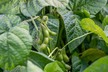
Michigan is experiencing its earliest outbreak of downy mildew in several years. Recent overcast, humid, and wet weather has given the downy mildew pathogen an ideal environment to thrive, particularly in major cucumber production regions. With more moderate temperatures forecasted, the risk of rapid pathogen spread and crop infection is expected to rise significantly.
The first cucumbers of the season, along with subsequent plantings, are now facing serious disease pressure due to the widespread presence of downy mildew in the state. The outbreak has been reported in pickling cucumber crops in southeast Michigan (Monroe and Lenawee counties) and southwest Michigan (Cass and Van Buren counties), unfolding rapidly over just a few days.
 © MSU
© MSU
Spore trap results have confirmed that the pathogen is widespread across many parts of the state. Even the cotyledons (first leaves) of newly emerging cucumber crops can become infected and show symptoms of downy mildew. A similar early-season outbreak occurred in Michigan several years ago, leading to substantial challenges and economic losses. Yield losses are most severe when plants are infected early and the pathogen is not effectively controlled.
Unfortunately, the list of fungicides that remain effective against downy mildew is shrinking, as the pathogen has developed resistance to several once-reliable options. This situation grows more concerning each year. To combat the disease, growers must now rely on remaining effective fungicides, used in combination with protectant fungicides such as chlorothalonil (for example, Bravo WeatherStik) or mancozeb (such as Roper).
Given the early and aggressive nature of the outbreak, a robust spray program is essential. This includes alternating among proven effective fungicides and tank-mixing with protectants. Based on 2024 field trials in Michigan, the recommended fungicides include Elumin combined with either chlorothalonil or mancozeb; Omega (also marketed as Orbus) combined with either chlorothalonil or mancozeb; Orondis Opti, which includes chlorothalonil in the premix (though additional chlorothalonil may be needed, subject to label restrictions); Previcur Flex combined with chlorothalonil or mancozeb; Ranman combined with chlorothalonil or mancozeb; and Zampro combined with chlorothalonil or mancozeb. Among these, Orondis Opti and Ranman are considered especially effective in Michigan based on multiple years of field trials.
Due to the rapid development of this outbreak and the conducive weather conditions, the spray interval should not exceed seven days. This schedule is manageable if fungicides are rotated as recommended. Always read and follow fungicide labels carefully, as the label is the law.
Growers are urged to act swiftly and proactively to manage this disease and protect cucumber yields in what could be a very challenging season.
To view the full report, click here.
For more information:
Michigan State University
Tel: +1 517 355 1855
www.canr.msu.edu