Hungary’s melon and watermelon season has started slowly and will be in full swing from next week as sizzling hot summer weather leads to increased consumption. However, the melon season is delayed by 10 days, with the recent hot weather speeding up development.
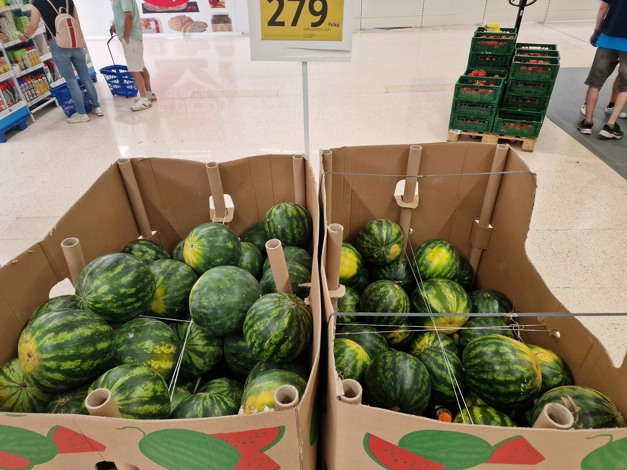
Watermelons for sale in a local Hungarian supermarket.
“The watermelon producers waited a bit for the start, but now there is nice demand in Europe and Hungary due to the hot weather that is forcing people to consume more watermelon,” says László Sándor, a melon expert from BASF Vegetable Seeds who is a trusted advisor to producers across Hungary.
The slower start to the season means that this week local producers were not able to supply the whole of Hungary. “Everywhere we can see partly Hungarian and partly imported watermelon. The quality and volumes of watermelon supply is increasing day by day, in a few days’ time there will be no need for imports only local production. Producers started to harvest from the middle of last week in few quantities. Now volumes have started to increase. Trucks can take sufficient volumes of watermelons to the wholesale and retail trade. Hungarian retailers are promoting watermelon at acceptable prices.”

The Gambey variety
Hungary’s watermelon industry, with a total of about 140,000 tons of production, is set to supply neighbouring countries with about 30,000 tons of exports. Most of this is sent to Poland followed by Czechia, Slovakia and then Germany. “Money wise Germany can be better; we are selling smaller watermelons with nice packaging and more seedless varieties. Volumes can even be increased this year. This is because of Hungary’s closer location to these countries and the transport costs that are a little bit lower than from competitor supplying countries to the same markets. However, the diesel price is still higher than previous years.”
Sándor says the production area in the South-East of Hungary, the biggest area for early watermelons, had no problem with the heavy spring rains. “The area close to the Croatian border and East Hungary has seen some parts of the field with about 5% under water, even after one week the heavy rain was still too much for the fields to absorb. This created a delay and lower yield with some losses due to fruit setting that was impacted. Fortunately in 95% of the production areas the watermelons developed well, it is not showing the harm of the past weeks. Last year’s watermelon plantations in Hungary covered 2,600 hectares and now it has grown to close to 2,900 hectares, a 10% increase, mainly in East Hungary, which saw a 20-30% increase. Country wide the good prices during August last year saw high demand with producers not able to provide enough supply. That is why they increased plantations.”
He says the demand in the size and type of watermelons that consumers want has changed again in one year. “There is a need for smaller seedless watermelons. One of the best is Gambey that is 4-6 kg. It is good for local retail and for central European retailers. We have the seedless also, medium small size is getting more and more popular. That’s what retailers ask form suppliers,” states Sándor.
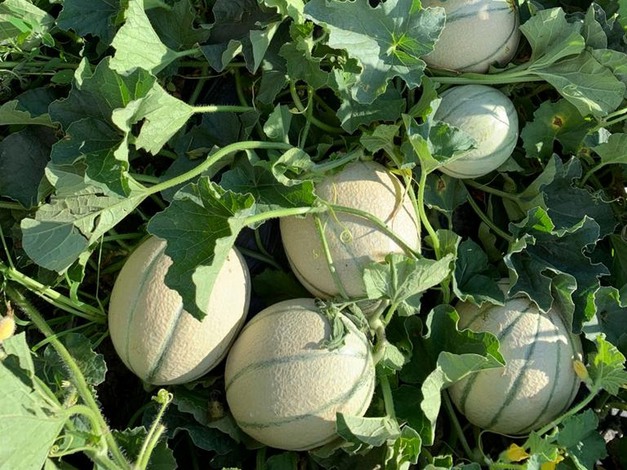
Melon in the South of Hungary before harvesting.
Fewer Melons
“The melon situation sees 20% less surface planted than last year. The season has seen a delay of 10 days at least. The last few days of hot weather makes the development faster. There was enough quantity on the wholesale market. This market is always sensitive to quantities with pricing that changes more rapidly and to a bigger extent. The supermarkets that receive the bigger part of the supply geared towards consumers, has room for improvement in taking on more quantities, which is difficult to import due to shortages in Italy and Spain. They will have shortages until mid-July. Later we will then see normal quantities on the market. There is more demand towards melons because a lot of fruit like apricots and peaches were destroyed by frost here in Hungary.”
He says although there are always plans to export melons to neighbouring countries, but at this time when there is a shortage in the country there will be no exports. “Although there are plans for now melons are only for the local market. The protected melon is seeing even bigger delays of at least 15 days. Some growers who have done early transplantations, started harvesting last week, with bigger volumes coming from this week. The open field low tunnels were removed a few weeks ago. They have now started harvesting low volumes with big quantities coming.”
For more information:
Laszlo Sandor
BASF Vegetable Seeds
Tel: +36 30 9356 722
Email: [email protected]
www.nunhems.com