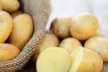
The Basque Institute for Agricultural Research and Development, NEIKER-Tecnalia, a public entity under the Vice Council of Agriculture, Fisheries and Food Policy of the Basque Government, has closed a research project on the potato varieties that best adapt to the expected conditions of climate change, with prospects of reduced rainfall and more extreme temperatures of heat and cold.
The project carried out by the technological centre seeks to identify the potato genes that confer tolerances or resistance in order to obtain new potato varieties that adapt optimally to future climatic conditions. The research also aims to find out how the current potato varieties will behave in a situation of greater drought and higher and lower temperatures. In short, this project aims to advance towards an improvement in the competitiveness of the agricultural sector, striving for a more sustainable agriculture.
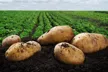
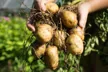
Potatoes (Solanum tuberosum)
Potatoes are the third most important food crop in the world, after wheat and rice (corn is predominantly used as fodder) and make a significant contribution to the world food supply. Most of the potato varieties currently cultivated are not adapted to the threats of climate change, but there are large germplasm resources in the form of wild potato species bearing genes that are important for the resistance or tolerance to different stresses.
Much of the genetic variety is found in the Andean regions of Peru and Bolivia. The objective of this project is to characterise the germplasm of cultivated and wild crops with regard to resistance and tolerance to different biotic and abiotic stresses using different molecular techniques and to exploit it through genetic improvement in order to obtain new potato varieties adapted to climate change.
Genomic studies offer the possibility of effectively characterising germplasm at the molecular level and to accelerate breeding programs. The detection of candidate genes for useful traits also makes it possible to apply them (after developing the corresponding markers) in marker assisted selection (MAS) in the framework of the improvement programs. The study of the allelic diversity of such genes in cultivated and wild species and the analysis of their particular effects allows for the selection of combinations of alleles and the identification or development of varieties that are more effective for these purposes.
The research is part of the Papaclima project and is being developed in partnership by NEIKER-Tecnalia, La Molina Agrarian University (Peru), INIAP (Ecuador) and the University of San Francisco (Ecuador) and is funded by FAO.
Benefits of the study
The project's research group estimates that at least 1,500 producers and their families would benefit from the use of developed varieties adapted to climate change, which would prevent production losses, thus ensuring food security and increasing incomes for local growers. The project will also contribute to changing and improving the food security of resource poor producers in certain developing countries by strengthening the sustainable management of plant genetic resources for food and agriculture.
Moreover, it is estimated that potato cultivation will increase by at least 10% in the coming years, especially in regions with adverse agroclimatic conditions. The project, which is coordinated by the Agrarian University of La Molina and NEIKER-Tecnalia, is developing and transferring the required technology. The project can help expand the frontiers of potato cultivation and thus reduce the impact of potato diversity loss and desertification.
NEIKER-Tecnalia technicians have collected genetic information from each variety at the time the plant is stressed; that is, subjected to adverse conditions of drought, cold or heat. In this way, you can see which genes are being expressed when the plant is under a certain stress. The technique makes it possible to identify the specific genes involved in the mechanisms of response to drought, cold and heat.
Identifying the genes that make the plant more resistant to drought, cold or heat is essential as a first step to develop new varieties that adapt to future climatic conditions. We then analyse the existing allelic variation of these genes and determine the effects of each particular allele or combinations of alleles on the degree of tolerance to the stresses studied, in order to select and combine adequate parental equivalents in the improvement programs. It also gives fundamental information to know how current varieties will respond to the effects of climatic change.
Detailed project information: http://www.papaclima.com/
Source: neiker.net