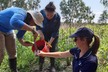
This summer, Murcia received China's authorization to export stonefruit; a milestone that opens the door to the world's largest market for the region's agriculture.
How is the sale of agricultural products to China?
It is growing. Products like citrus fruits, wine, olive oil and not many more had been exported for years, but this season has been the first for stonefruit.
Why has it taken so long to sell them stonefruit?
All countries have phytosanitary controls and these are difficult to negotiate. The Spanish authorities have been in talks with the Chinese authorities for four years, just to be able to sell them stonefruit. This year, all the hard work has finally paid off and the protocols have been signed, so the shipments have already started this summer.
Is everything exclusively intended for a high level market?
For now, yes. The logistics costs and tariffs are expensive, so the products must be of good quality and targeted to the upper middle class which can afford them.
What does China see in our products that it doesn't see in its own?
China has its own production, but since the middle class has been growing in recent years, the people now have money and demand better quality products and a wider range. In fact, China also imports fruits from Australia, New Zealand, the United States and Chile.
Do they believe that foreign fruit is better?
Yes, especially if we are talking about the products that we have just started shipping there: peaches, nectarines, plums and mainly Paraguayo peaches, which people really like over there.
What other Murcian agricultural products are likely to reach them in the future?
There are good prospects for the signing of more sales agreements in the future. For example, the Chinese have shown interest in our grapes, melons and watermelons, and our pome fruits are also considered attractive.
What needs to be done for these products to be added to the list of exportable ones?
Negotiations are underway. You already know that Chinese officials have come to inspect the manufacturing processes, the boxes, the fruit quality, etc., and that they are preparing reports. There are no problems, but a little more time is needed.
How much time?
I think the process will finish this year or the next.
What is the best way to export agricultural products to China?
The fastest way is by air, but that can be quite expensive; around 1.7 Euro per kilo. By ship, which costs 20 cents per kilo, is the most comfortable, but it takes a month or longer, which can be too much time for the fruit, although this is often used to enforce the compulsory quarantine, of about 18 days. We must make sure that the fruit is not carrying larvae of the whitefly, for example.
As for rail transport, it takes between two weeks and about 18 days from Madrid to a city in the south east of China, near Shanghai, called Yiwu. It arrives in pretty good condition and the price is good, 15 cents per kilo.
What should be done by a Murcian agricultural exporter willing to sell to China?
It should go to the Administration, to the Council, and enrol in a list which already includes many companies in the region of Murcia. Chinese officials often come to inspect the quality and arrange the compulsory controls.
Besides agricultural products, how is the market for agriculture-related products, such as irrigation systems, for example?
It is a derivation of the same. There will also be an increase in the demand for these services (irrigation, fertilisers, etc.). China is interested and I think there are also negotiations underway through contacts between institutions. I know some companies that are already selling irrigation systems. There is business going on.
Can the current opening also lead to the sale of Chinese agricultural products here?
Not for now, because the Chinese market has high demand which the country is unable to cover with its own production. I do not think any Chinese agricultural product will be shipped to Murcia (or any other part of Spain). On the contrary, China's demand for foreign products is on the rise.
Is there interest in investing in Murcia's agriculture?
Yes. Delegations are already arriving and expressing quite an interest in buying properties, factories, warehouses or farms here.
Given the difficulties in exporting to China, do you think people exaggerate when they say that the world's largest market is opening its doors to Murcia?
No, that is just the reality. We are gaining access at a time when China has a tremendous demand, because it is a tremendous market. At the moment, there are about 150 million Chinese people with the means to buy foreign products. If China reaches the general level of European consumption, then there will not be enough production to meet the demand. That's no exaggeration, as right now we are just talking about a group of 150 million people from a total of 1,300 million. This speaks volumes about the market's potential for the future.
Source: laverdad.es