Approximately one year ago, Koen Vanswijgenhoven became manager for VLAM Germany. VLAM promotes Belgian fruit and vegetables in abundance in the neighbouring country, and Koen is responsible for properly managing this, and for giving advice to the Belgian fresh produce sector afterwards. “I closely follow all that is going on in the German fresh produce sector, and talk about this extensively with our Belgian exporters and auctions.” Koen is from Hasselt, and did much work in the food industry, so fruit and vegetables were not unfamiliar to him.
Germany
It is a trend that German consumers prefer local product. “It differs per supermarket chain, but various retailers emphasise regional products. This does not immediately threaten Belgian fruit and vegetables, because they are still being sufficiently imported, for many products do not sufficiently meet demand, regionally speaking. Additionally, they are fairly expensive. The local-for-local story would only becomes disrupting if it were to become a national story. Another argument is that many Belgian regions are much closer to certain German regions than to the northern German states. What would be local then? I therefore do not see the ‘local trend’ in Germany as a threat to the export of Belgian fresh produce.”
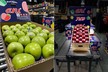
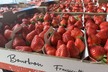
Top fruit on the fresh produce shelves in a German supermarket.
Pear promotion
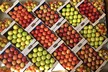
Over the coming three years, the Netherlands and Belgium will once again promote their Conference pears on the German market. This action is supported by the European Union. “The most important pear in Germany is currently the Abate Fetel, and we would like Conference to also be put on the shelves. It is remarkable that consumers can choose from a great number of different apple strains, but pears do not even have an assortment. The pear shelf should be more varied. In Germany, pears are seen as fruit for old people, so we focus on young people and families. There is an enormous potential, and not just for Conference. The majority of the promotions are being done in North Rhine-Westphalia, but we also expand to other states each year. Eventually, we want to reach all of Germany with our Conference. We are looking for partners who want the pears on their shelves for longer periods.” According to Koen, Germany is not a ‘solution’ to the Russia-problem. “Russia bought an enormously large volume, you cannot make up for that with just Germany. It is good to focus on multiple countries together. The pear sector has now learned not to bet all of its money on one horse.” He sees that Germany really needs promotions for the long term. “Other European countries are quick to pick up novelties, but Germany is much more conservative. It takes a long time when introducing something new before it is accepted.”
Other vegetables
Not just pears are being promoted in Germany, but other products, such as butterhead lettuce, leek, chicory and tomato, as well. “This is always done in cooperation with auctions and exporters. We have a general Flandria promotion, and, additionally, we have specific promotions to put extra focus on certain fruits and vegetables. And we clearly see the results of that. With certain products we have reached the limit though, and we should not force that even further. The intention is that we keep trying new things. Leek is doing very well now, and tomato specialities also have good demand. We continue to follow the market’s demand.” According to Koen, retail in Germany needs more types of fruit and vegetables and a wider assortment in general. “To them, it would be perfect to have more on the shelves, the more choice, the better. That is how they can distinguish themselves from discounters, who are increasingly adding ambiance to their shops.The difference is now mostly in the width of the assortment and the experience.”
Important market
Approximately 25 per cent of Belgian fruit and vegetables is exported to Germany, so it is an important market. “We naturally want to grow in this country, but the percentage should not become too high. It is good to remain active in multiple countries, and to spread focus. We learned something from Russia, and with VLAM we also ensure a correct segmentation in promotions. Additionally, we distribute budgets as well as possible, and we will continue to invest in Germany for now. We re-evaluate the plan for Germany every year, and are looking for the right partners who want to work with Belgian products.”For more information:
Koen Vanswijgenhoven
Regional manager Germany, Northern and Eastern Europe
T +32 2 552 80 60
www.freshfrombelgium.com
[email protected]
[email protected]
VLAM vzw - BE 0454 423 323
Koning Albert II-laan 35
bus 50 - 1030 Brussels- Belgium