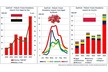
Turkey is currently not taking full advantage of its climate, which is well suited to the cultivation of various fruit; amongst these the most important being grown are apricots, hazelnuts, cherries, peaches, apples, quine, oranges and lemons. Breeding studies could increase and improve the production of apricots in particular.
There are 2,500 registered apricots in the world. In Turkey between the years 1941-45 the Malatya Apricot Research Station developed the Sekerpare and Alyanak varieties. Between 1960-1989 various other varieties were also developed, such as the Kadioglu, Soganci, Adilcevaz series the Turfanda Eskimalatya apricot and more. The most recent variety, the Alkaya, was developed in Malatya in 2010.
In 1999 the Inonu University Apricot Research Center, launched the, "Multipurpose Apricot Breeding Project" under which the Dilbay and Eylul apricot varieties were developed.The centre is currently working on more than twenty apricot varieties which have various characteristics such as disease resistance, early, mid-season, and late ripening.
In a 30 year period from 1980-2010, 614 apricot varieties were developed globally. Of these, 87 were developed in the US, 79 in France, 71 in Italy, 47 in China, 43 in Spain, 29 in the Czech Republic and 21 in Israel. Turkey, which has the monopoly on fresh and dried apricot, only produced 9 varieties, which suggests insufficient work is being produced in the breeding sector.
Future expectations
Plum pox virus is a serious disease affecting stonefruits and new apricot varieties resistant to the disease are being developed. Work into early, mid-season and late ripening varieties also continues.
Turkey is well behind other counties in modern apricot breeding studies and to be able to compete it is vital that the Agriculture Faculty, the Agriculture Ministry and seedling producers in the private sector, establish close cooperation and perform extensive studies.
Source: malatyahaber.com