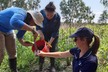
The Urban and Suburban Agriculture Programme has expanded throughout Cuba with the goal of turning every plot of arable land into productive areas in order to increase food supply and meet the demand of the local population.
After almost 27 years since its creation, this system has consolidated as an extensionist productive movement consisting of organoponics, intensive plots, family farms and suburban plots.
Sector authorities argue that since its introduction, this type of farming has proven to be a "sustainable" production movement, with participation from the community and the advantage of bringing products closer to the consumer.
Its main goal is to increase food production in order to reduce costly imports in an area that is considered strategic for the country's economy.
The project started in December 1987, and after going through various stages, it adopted its current name in 2009 and began covering the production of food, medicinal, ornamental plants and flowers, forestry and other agricultural activities within the city and town areas and their surroundings.
Among its major achievements include an improvement in the supply of fresh vegetables, spices and fruit, among other products, as a result of wage payments for productive results.
Another benefit is the reduction of pressure on lands subject to many years of exploitation, where it becomes more expensive and difficult to maintain crops.
Nelson Campanioni, executive secretary of the programme, reported two days ago on local television that the movement currently covers more than 96,000 farms in the country, and produces 50 percent of the vegetables consumed by the population.
He pointed out that these farms also cultivate fruit, bananas, forestry, coffee and cocoa, flowers, medicinal plants, beekeeping and seeds, besides poultry production and aquaculture.
"Since the UN announced that 2014 would be the Year of Family Farming, we have been engaged in the development of many activities devoted to that, which will conclude in 2015 with a major event," said Campanioni.
Julio Martínez Roque, Delegate of Agriculture in La Habana, stated that in the case of the Cuban capital, the most populous and urbanised area in the Caribbean nation, the plan is increasingly gaining more followers and has already extended to over 700 farms in its 15 municipalities.
In Cuba the revival of agriculture to increase food production is seen by the government as an "urgent challenge" and a matter of "national security" to reduce imports, which in recent years exceeded 1,500 million dollars in food purchases.
Sources from the Ministry of Agriculture stated that the major challenges of the programme are in the provinces of the eastern end of Cuba, where the soils are mostly infertile, mainly affected by salinity and erosion.
Another challenge is to increase fruit production and "rescue" those products that have almost disappeared completely from Cuban plantations, such as loquat, cherimoya, sugar apple, soursop, star apple and bergamot.
According to UN data, almost half of the world population is devoted wholly or partly to agriculture, with the largest share of them being in Africa, Asia and South America.
Source: china.org.cn