The 2013 banana campaign seemed to be going well especially and January and until mid-February. Then, however, consumption and demand did not increase because of a series of concurrent factors.
This is the analysis of Vittorio Grotta, CEO of Dole Italia, who adds that "we had to sell too much produce from the end of February and March, as rigid temperatures in Northern Europe and Russia meant we could not transfer it. Many batches that were stuck in Saint Petersburg piled out on the market all at once. In addition, in Southern Europe and in the Mediterranean basin the effects of the economic crisis are slowing down consumption, therefore the market is performing worse than expected."
Talking specifically about the Italian market, 27 millions boxes are handled annually. "It is a mature and consolidated market where shifts in consumption are only marginal and they depend on the weather. I'd say that looking at the market on the whole, the trends of imports and consumptions have been decreasing over the last few years. Northern Europe has the same tendency."
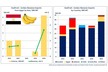
Tendencies of the imports of bananas, pineapples and exotic fruit in Italy in 2011 and 2012. (Source: FruitImprese).
Only some of the lesser segments of Dole's banana supply seem to be counter-trending. "I'm thinking about organic and fairtrade bananas, which are on the rise despite the economic crisis. Dole is the first importer of organic bananas in Italy and has also introduced organic pineapples. We are anyway talking about volumes that represent less than 3% of the total handled produce."
There's quite an interest also for niche products such as plantains (cooking "bananas") or baby bananas: "There's a demand for ethnic food especially from the population coming from Asia or Latin America who live in Italy."
The consumption of bananas in Italy is concentrated during Autumn and Winter, which is when the schools are open. "The only non-seasonal demand is that coming from sportsmen, who eat bananas as a source of potassium, which is important for muscles." At the moment though, there's no market for banana-based processed products.
Two thirds of Dole's banana supply is destined to mass retailing, whereas one third goes to normal trade. "Even in such a consolidated market like the Italian one, opportunities are created by keeping the quality and the service constant."
Shipping and ripening of bananas
The produce arrives in the Civitavecchia and Livorno harbours. Bananas are then sent to the various ripening centres; Milan and Bologna in Northern Italy and we collaborate with other partners in the South.
About ripening centres in Italy, Vittorio Grotta says that, "from the 1960s up until today there has been a concentration process. Once, there were around 300 companies dealing with banana ripening at a local/regional level. Nowadays though, there are only a few dozens of centres. Operators are bigger, professional and equipped with the logistics to supply destinations that are 400-500 km away."
Dole Earth
After the great success in Northern Europe, last spring the "Dole Earth" campaign arrived in Italy. For this campaign, Dole Earth has been awarded the "HAMMA Award" for the most creative marketing campaign of 2012.
Thanks to Dole Earth, consumers can find out in which plantation the banana they bought was grown.
In fact, Dole bananas have a new label and a 5-digit farmcode for each plantation.
By typing in the code on www.dole-earth.com, consumers can trace the plantation in which their banana grew.
They will also receive information on the plantation and on the certifications of both the region and the country of origin.
Consumers can take an interactive tour of the plantation, during which they will see the whole productive process and meet some of the people who work there, just like a guided tour.
Consumers can take an interactive tour of the plantation, during which they will see the whole productive process and meet some of the people who work there, just like a guided tour.