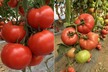
Greece imports 12 million Euro of tomatoes
This is what most Northern European countries do - the difference in Greece being that they have the perfect climate to grow their own tomatoes.
So what are the reasons for the importation? The Dutch tomato, for example, is produced using the most modernised production methods at low cost and deliver consistent quality. Most importantly, tomatoes are produced in such quantity in the Netherlands that the price is low.
In Greece, contrastingly, the market is chaotic at the moment. In Crete, for example, co-operatives hand over their produce to traders without a receipt, meaning that they have no idea how much their produce will be traded for.
As far as prices are concerned, according to Aristotelis Panteliadis, CEO of the Metro cash-and-carry chain, imported tomatoes are no cheaper on average than domestic varieties when bought in bulk. But, he explains, the cost for the foreign producer is much lower, giving them a higher profit margin.
As Constantinos Akoumianakis, an assistant professor at the Agricultural University of Athens says, "foreign farmers have huge greenhouses and hydroponic production methods. This is precision farming that covers all the plants’ needs, while at the same time conserving water, nutrients and, of course, money."
On the other hand, most local farmers use old-fashioned methods and are hesitant to try new varieties for which there is a demand in the market.
2011 was, however, the first year in many that the country also succeeded in some exports: 14,470 tons worth just 6.2 million Euro - though this is a low price.
The situation has led some Greek farmers to question the way they are doing things.
On the island of Paros, Christos Lazanakis started a hydroponic greenhouse in 2008, hoping to boost production while lowering his operational costs.
"You need to follow a very specific fertilization and watering regime for each crop," explained the greenhouse owner.
The company Wonderplant is also moving along high-technology lines, with a hydroponic unit of 120,00 square meters in Drama, northern Greece, which is expected to produce 7,000 tons of tomatoes throughout the year.
There are still obstacles though, Wonderpland MD, Themis Makris, said that the technology his company is using may be Dutch, but the environment he is operating in remains very Greek - he is paying twice as much for his energy than he would do if he was based in the Netherlands.
"We use natural gas and pay 60 Euro a megawatt - as much as household consumers do - while Dutch farmers pay exactly half that," he said.
Source: www.ekathimerini.com