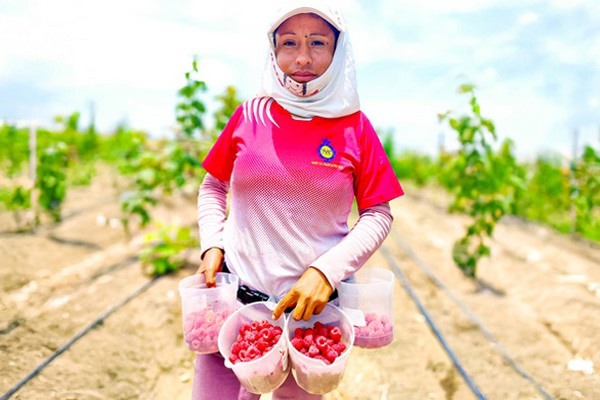
Raspberries are emerging as an important crop in Peru's efforts to diversify its fruit production. Agromercado, an entity affiliated with the Ministry of Agrarian Development and Irrigation (Midagri), highlighted this during the webinar "Commercial trends of raspberry cultivation in Peru," which analyzed the international market and opportunities for this high-value berry.
According to data, global raspberry production reached 920 million tons in 2024, driven by steady growth from the main producing countries: Russia, Mexico, Serbia, the United States, and Poland.
 © Midagri
This dynamism is also evident in the international trade of frozen berries, which, under tariff heading 081120, covering raspberries, blackberries, and currants, generated approximately 1.251 billion dollars in the same year.
The European Union remains the main consumer market. Germany, for instance, records a per capita consumption of about five kilograms of berries annually, and demand continues to grow. This creates opportunities for exporting countries that can ensure quality, consistent supply, and adherence to sanitary standards.
In this context, raspberries stand out not only for their commercial appeal but also for their nutritional profile, which features high levels of antioxidants, fiber, and vitamin C. Additionally, they align well with the healthy eating preferences of European consumers.
Peru primarily exports frozen raspberries. According to Agromercado, 95% of shipments go to the United States and 5% to Chile, which indicates there is significant potential for diversifying destinations, especially toward the European Union.
Although the crop is still in early stages compared to established berries like blueberries, Midagri emphasized that its potential relies on scaling production, organizing supply, and meeting market demands for volume, continuity, and logistics.
The country's top agro-exporters have shown interest in adding raspberries to their offerings, primarily for export as frozen products, pending industrial testing. They are drawn to the advantages, such as a six-month production cycle, a shelf life of up to 15 years, and high yields per hectare.
In addition, it allows a dual commercial orientation: fresh and value-added products for domestic consumption, and frozen products for export.
The webinar organized by Agromercado delivered a compelling message: raspberries are a strategic opportunity to boost Peru's agro-export supply with high-value products and increase global demand.
For more information:
Ministry of Agrarian Development and Irrigation (Midagri)
www.gob.pe