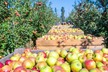
As rising production costs squeeze profit margins, effective crop load management has become essential for apple growers. A new research initiative underway at Montague Farms' Legana Orchard in Tasmania is exploring precision thinning strategies aimed at producing consistently high-quality fruit with reduced labour and chemical input.
Led by TIA Tree Crop Physiologist Leticia Reis, the project is part of the PIPS 4 Profit Optimising Apple Production Systems (AP22004) initiative. The trials focus on thinning methods to help manage crop load more efficiently and avoid biennial bearing. Targeted strategies aim to achieve optimal fruit set early in the season, reducing the need for hand thinning and lowering overall input costs.
 © APAL
Trials are being conducted on Simmons, Scifresh, and Ambrosia cultivars (marketed as Buckeye Gala, Jazz™, and Ambrosia™). The research examines combinations of chemical thinning agents, including ammonium thiosulfate (ATS), Ethrel, Sevin XLR Plus (carbaryl), MaxCel (6-BA), and Brevis (metamitron), and assesses timing, concentration, and environmental risk factors like frost and phytotoxicity. Newer options like Accede (1-ACC), which has shown promise overseas, will also be explored as it becomes available in Australia.
The trials also take into account environmental and worker safety concerns, seeking to reduce chemical exposure and explore more sustainable alternatives to traditional thinners like carbaryl. Orchard Manager Rod Hogan and Assistant Manager Adam Hogan emphasise the importance of applied research in guiding practical decisions, noting that precise data can validate observations in the field and drive smarter investment in crop management tools.
 © APAL
In the first season, data collected included fruit set, yield, and labour hours for hand thinning, helping to evaluate the economic impact and operational efficiency of each treatment. Early-season thinning has been shown to improve fruit size and return bloom while reducing yield variability.
The project's ultimate goal is to give growers confidence to adopt integrated, climate-resilient thinning programs that support long-term orchard health and profitability. By testing methods in a commercial setting, the research aims to provide real-world solutions that reduce reliance on chemical sprays, improve fruit quality, and streamline labour, all while promoting sustainable farming practices.
To view the full report, click here.
 © APALFor more information:
APAL
Tel: +61 3 9329 3511
Email: [email protected]
www.apal.org.au