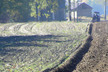
A documentary by the German public television network Das Erste (ARD), entitled "Europe's dirty harvest. The suffering behind the fruit and vegetable business", has generated a controversy in Germany over the fruit and vegetables from Spain and Italy that are sold in German supermarkets. Germany is one of the main markets for Andalusian agricultural products and the television team travelled to Almeria to portray the situation of the undocumented immigrants who work in the greenhouses of the area.
"Our search leads us to shacks made from scrap. It's incredible that this is happening in Europe. This is a home for the poorest among the poor, for people who work for us." The goal is to answer the question: "where do our fruit and vegetables come from?"
While showing images of a shanty town built with discarded plastic nearby the greenhouses, the narrator says that "thousands of immigrants live here; the shacks have no water or light, and here mothers also live with children." According to data from the Andalusian Union of Workers contributed to the report, there may be about 4,000 people living in these conditions in Almeria.
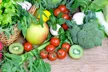
Asked at the exit of a supermarket, several German customers who have bought vegetables say that "Spain is fine; it is a European country." Spanish products are especially cheap in German supermarkets, explain the reporters. In 2017, Spain exported vegetables and fruits to Germany worth 3,800 million Euro.
Berlin activists support immigrants
The video features the association Interbrigadas, of Berlin, which protested in Almeria in front of the headquarters of the company Eurosol. Some 120 people are part of this association and their work is voluntary and unpaid. "Twice a year, we go to Almeria to support the work of the SAT union," explains a spokesperson for the association. "We want to improve the working conditions of seasonal workers who produce our vegetables and support the work of the SAT."
In the report, it is assured that of the 47 Euro a day that should be the minimum legal payment, temporary immigrant workers with the necessary permits only receive about 35, and illegal immigrants get little more than half, about 25 Euro. German journalists are amazed that overtime is not paid, or that bosses refuse to offer indefinite contracts. And safety clothing is not provided in many cases.
One of the companies denies the accusations
Working without protective clothing while spraying is something that a labourer employed by the company BioSabor was allegedly forced to do, says the documentary. Its president, Francisco Belmonte, sent a letter to the newspaper explaining that they feel "perplexed and outraged by the statements made in the documentary." He assures that the labourer is still employed on their farm and that it seems "unfair and irresponsible to say that BioSabor does not respect the rights of workers."
One of the key points of the documentary is its criticism of the fact that the European subsidies paid to farmers are not accompanied by strict controls to prevent labour exploitation.
They ask Martin Häusling, MEP of the German Greens, about the position of the EU. He assures that it is a form of "modern slavery," adding that "we no longer go to Africa to exploit people, but we exploit Africans directly here." A spokesperson for the NGO Intermon Oxfam in Germany blames the big German supermarkets, asking them to enforce new pricing policies so that labour standards can be implemented in southern Europe without resorting to exploitation.
Source: eldiario.es