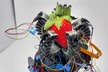
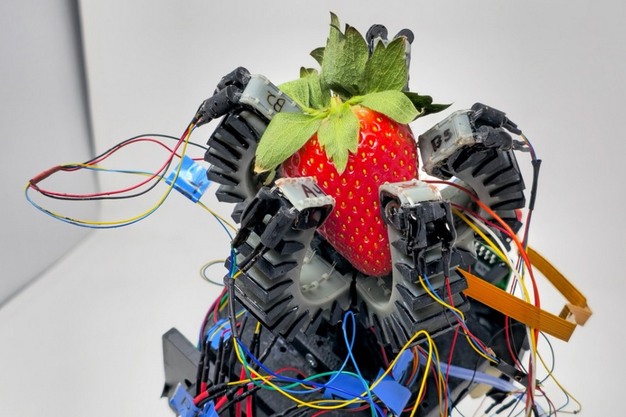
Researchers at Cornell have developed a soft robotic gripper using stretchable fiber-optic sensors to assess fruit ripeness by touch and harvest strawberries without damage. The system measures firmness and uses a twisting motion to remove fruit from the vine.
The research, published March 23 in Nature Communications, was led by Anand Mishra in the lab of Rob Shepherd, John F. Carr Professor of Mechanical Engineering. The team worked with Marvin Pritts, professor of horticulture, to develop applications for berry production.
 © Cornell University
"The great thing about Cornell is we're a really great agriculture school, and a lot of avenues are opening up because of it," Shepherd said. "It really allows us to uniquely combine our robotics expertise with our agricultural prominence."
The gripper is equipped with two fiber-optic sensors that measure curvature and pressure. This allows the system to estimate shape and adjust grip to avoid damage. "The fiber-optic strain gauges have the same mechanical properties as the grippers that are using them. So it's kind of like the flesh feels the fruit, rather than having separate sensors," Shepherd said.
The system was trained using strawberries as a model crop. "You can accurately tell when strawberries are ripe by their color," Shepherd said. "So we could train our model to know if it's ripe based on touch, then validate our model by looking at the color. And Anand was able to accurately estimate whether it was the right time to pick strawberries based on the stiffness he measured."
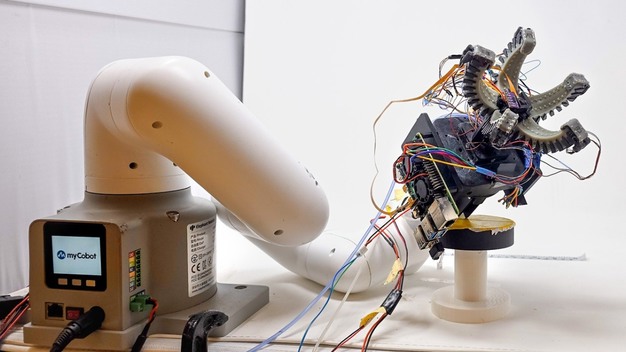
Once the fruit is grasped, a planetary gear mechanism rotates the gripper to detach the fruit without pulling. A camera is also integrated to identify fruit obscured by leaves.
 © Cornell University
The system may be applied to crops where ripeness is not easily visible, including avocados, pineapples, and pawpaws. "The problem with pawpaws is you can't see when they're ripe, and they ripen so fast that if you're not there at the right time, you just miss them," Shepherd said.
Researchers indicate that robotic systems could support production models with multiple crop species and reduce reliance on pesticides and fertilizer. "Robots will allow us to do things we cannot do economically right now," Shepherd said. "It's very complicated to manage a farm that way, and robots could allow us to do that."
For more information:
Becka Bowyer
Cornell University
Tel: +1 607 220 4185
Email: [email protected]
www.news.cornell.edu