Quality inspection has become a non‑negotiable layer in fresh‑produce trade since the West Asia disruptions hit, says Bhushan Yalmar, CEO of Zorro QC, Mumbai. "Demand for our services has gone up by roughly 35–40% because the war‑related rerouting, prolonged transit, and sheer uncertainty made independent quality data essential for serious traders. Since we gather insights about the condition of the market from multiple geographies, we share those with our partners for better decision-making."
Bhushan points to Indian grape exports to Europe as one of the starkest examples: "Some shipments that were meant for 36–40 days at sea ended up at 70–75 days, with containers still stuck at sea months later. Grapes are not meant to be on water for 75 days; affected shipments have shown severe quality deterioration, leading to a tremendous reduction in value due to quality degradation for exporters who loaded large volumes of 150-200 containers on those vessels."
"Rerouting does not invent new problems; it exposes the limits of how long fresh produce can stay in transit," Bhushan stresses. With Polish apples, for instance, the Zorro team observed a firmness drop of 0.5 to 0.7 kg/cm² above normal pre‑shipment levels, with some shipments losing close to 1 to 1.5 kg/cm², effectively eroding most of the expected firmness buffer. Similar patterns appear on Egyptian citrus, where crease marks and internal breakdown surfaced when journeys are stretched.
 © Zorro QC
One of Bhushan's observations about the ongoing war is that buyers' tolerance for defects did not uniformly improve. "While some accepted lower quality because supply was short, for many it became a negotiation lever. If there was even a minor concern, some buyers used the war-related disruption as an excuse to push for lower prices," he explains. "In such situations, a clear arrival QC report with photographs and data gives the exporter something concrete to stand on, not just a dispute over opinions."
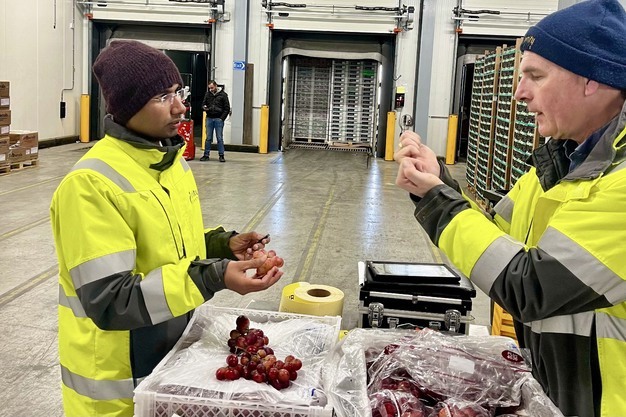
During disruptions, Zorro QC tightens its inspection in three areas: First, sample sizes increase to capture the real‑world variability in extended‑transit lots. Second, the focus shifts from visual checks to internal defects such as firmness loss, internal breakdown, and early breakdown symptoms that are not visible from the outside. Third, temperature‑record review becomes central, as a cold chain failure at any point in a long journey can quietly accelerate deterioration. "When combined with arrival QC, this data becomes crucial evidence for claims against shipping lines."
Making independent arrival QC the default in every contract, not just a last‑resort measure when a dispute arises, is something Bhushan advocates. "In India today, most quality checks happen only after a claim is raised, and by then, nobody can agree on what the cargo looked like on arrival. But if every container had an independent QC at arrival, it would drastically reduce friction and late claims."
He sums up by urging traders to bake in transit‑linked tolerance and QC terms in contracts. "Most contracts today define quality at a fixed point without accounting for route variations or extended transit times. In a world where shipping disruptions are becoming more common, traders need to have honest conversations about what happens to quality when a 36-day voyage becomes a 75-day one, and agree on how that risk is shared before the cargo moves, not after it arrives."
For more information:
Bhushan Yalmar
Zorro QC
Tel: +91 70 35 364 747
Email: [email protected]
www.zorroqc.com