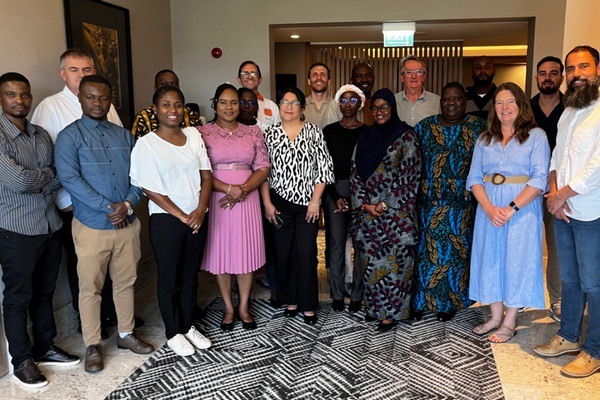
The International Potato Center (CIP), in partnership with national research institutions, has launched a multi-country initiative to validate sweet potato varieties for deployment across Sub-Saharan Africa. The project was introduced at a meeting in Nairobi, bringing together participants from Nigeria, Uganda, Tanzania, Malawi, and Mozambique.
The initiative focuses on late-stage validation to prepare varieties for multiplication and release through national systems. While most sweet potato production in Africa remains based on white-, cream-, and yellow-fleshed types, orange-fleshed sweet potato is used to address vitamin A deficiency. The project targets agroecological zones including drought- and heat-prone areas, regions with high virus pressure, and the savanna–Sahelian belt covering more than three million hectares.
 © CIP
© CIP
The program applies Advanced Yield Trials and On-Farm Variety Trials using Tricot technology. Farmers will evaluate candidate varieties under production conditions, based on yield, maturity, resilience, and culinary traits. Consumer preference tests, sensory analysis, and laboratory assessments are also included.
Several candidate varieties from previous breeding programs are entering validation. In Uganda, Mozambique, and Nigeria, some materials have shown higher yields compared to commonly grown types, combined with dry matter performance and consumer acceptance. These will undergo national trials and registration, with at least three varieties expected to be released during the project period.
The project links CIP with National Agricultural Research Systems to support data harmonization, breeding networks, and digital tools for decision-making. Demonstration plots and cooperation with extension services and community organizations are included to support adoption.
In Nigeria, Solomon Afuape said: "I am confident that farmers will achieve yield increases of at least 20 to 25 percent under normal field conditions, which will significantly enhance productivity and profitability."
In Tanzania, Hadija Ally noted that local varieties remain widely used due to dry matter content. The project introduces varieties combining yield, dry matter, and tolerance to pests and diseases.
In Mozambique, Neila Albertina Maicel said the program supports processing and product diversification, including sweet potato-based foods.
In Malawi, Andrew Mtonga stated that adoption remains limited due to supply chain and market constraints, with the project targeting yield improvements of at least 25 percent.
The initiative is open to additional countries seeking access to breeding materials and support through institutional channels.
 © CIPFor more information:
CIP
Tel: +511 349 6017
www.cipotato.org