Banana growers around the world aren't just battling the stubborn soil-borne fungus Tropical Race 4 and diseases like Moko and Black Sigatoka. Water scarcity, rising costs, declining average yields, and growing market pressure to farm more sustainably are also keeping them awake at night. A previous article explained how A Better Choice (ABC), a Dutch agritech company, keeps TR4 and Ralstonia—the bacterium behind Moko—out of plantations by disinfecting irrigation water with UV-C. In this follow-up, founders Roland Heringa and Jasper van Roon share how they've built a cultivation system in the Philippines designed to tackle those other challenges head-on.
Water technology is only one piece of the puzzle. A Better Choice also developed the Premium Cultivation System (PCS): an integrated approach to banana production designed to give growers a viable path forward in a market where disease pressure, climate change, high costs, and water scarcity are converging.
ABC initially invested heavily in research into substrate cultivation under netting, but it turned out to be impractical. "Disappointing, but it gave us valuable insights for open-field cultivation," says Roland. Using those lessons, ABC developed PCS into a soil-based growing system that aims for higher yields with less water and fewer crop-protection products.
PCS rests on three pillars: the system itself, on-the-ground grower support, and shared risk. When a grower is interested in planting, ABC starts with a soil analysis. "If the field is contaminated with TR4, we tell the grower there's no point growing bananas there. Other crops may be suitable, and we advise on that too," says Roland. Irrigation water is also tested; if needed, UV-C treatment is recommended.
Pillar 1: The system
During cultivation, the Crop Management System (CMS) takes over: a digital platform that provides nutrition programmes by growth stage, powered by data from sensors, QR scans, and field visits. "We have the world's largest banana database," Jasper says. "Researchers want to work with that data, for example, for infrared image recognition and early detection of Black Sigatoka. The earlier you intervene, the fewer inputs you need."
"With a healthy starting point and the right conditions, you can get by with far less chemistry," Roland says. "CMS goes back to basics: no forced growth, more biodiversity, biostimulants. Healthy plants are more resilient and more productive." That ties in with the Plant Empowerment Model (PEM), which puts light, nutrition, and water at the centre.
"Everything is about balance," Roland explains: taking in and losing energy; absorbing water and transpiring it (for transport of nutrients and cooling); producing sugars and consuming them. "Only healthy plants can keep those ratios in equilibrium. Data-driven decisions let you steer much more precisely, using fewer inputs. That's when you're truly innovating."
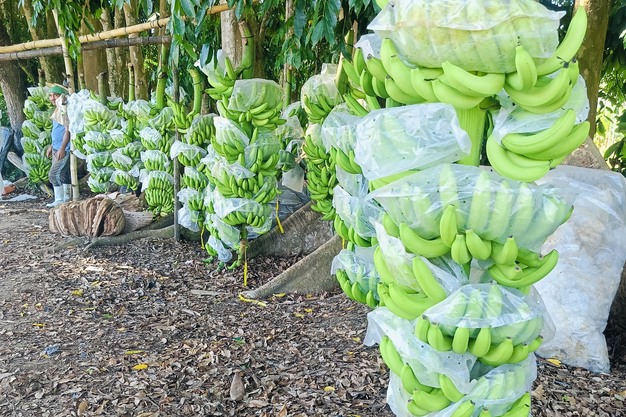
Early results in the Philippines are promising: average production has increased from 25 kg per plant to 40–52 kg, with less plant loss and lower use of both water and crop-protection products. Low MRL levels also increase product value. "What we're harvesting so far easily meets export standards," Jasper concludes.
 © A Better Choice
Average production has increased from 25 kg per plant to 40–52 kg.
Pillar 2: Support in the field
Even so, the barrier to entry for many local growers initially proved high. "They saw a mountain of technology they didn't know what to do with. We underestimated that," Roland says. That's why ABC now also provides training and technical support. Working with local partners, the company takes care of maintenance for the installations. Online learning materials help engineers and growers learn how to work with the system. And it doesn't stop at technology and nutrition programmes: biosecurity remains critical. "It all starts with discipline in the field," Jasper stresses.
Pillar 3: Partnership, not a one-off sale
Financing is often the bottleneck, especially in countries where plant diseases can cause up to 20% yield loss each year. "That doesn't leave much room to invest," says Roland. So ABC doesn't sell the system as a traditional product, but offers it as a service: growers don't pay a large upfront amount, but contribute per carton of bananas harvested. "We're not a supplier, we're a partner," Jasper says. "We share the risk and make sure it works."
That comes with conditions: at least 20 hectares and a contract with an international buyer. In the Philippines, an estimated thousand growers would qualify; ABC aims to onboard a hundred of them within three years. Without any marketing, ten growers have already committed. "The first field starts in a month," Roland says.
Looking beyond bananas
The ambition goes well beyond bananas or the Philippines. ABC wants to adapt the system for other crops such as coffee, avocado, and other tropical fruit, with local expertise at the heart of the approach. Although founded by two Dutch entrepreneurs, ABC leaves cultivation and execution to local teams of engineers, scientists, and crop specialists. "We're not going to tell them how to grow bananas," Jasper says. "They already know best." Collaboration with Wageningen University & Research and Dutch cultivation know-how in high-tech environments complements on-the-ground experience.
A scaling fund
To accelerate rollout, ABC is working on an investment fund. The first pilot fields in the Philippines are still being financed from ABC's own resources, but to reach 100 fields within three years, discussions are underway with banks and investors. "Our proposition is financially attractive," Roland says. "Profitable for the grower, but also for investors and for us."
Jasper sums it up: "Everything starts with water: keep diseases out with UV-C. Then comes the Premium Cultivation System, which—combined with biosecurity and smart crop management—delivers higher yields. And when you bring together cultivation systems, education, and financing, you can create impact worldwide."
 For more information:
A Better Choice
Rijksstraatweg 145
7391 MK Twello (The Netherlands)
Tel.: +31 (0) 6 52321450 (Jasper van Roon)
[email protected] (PCS en CMS)
[email protected] (UV-C)
www.abetterchoice.nl