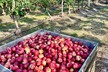
At the 39th International Blueberry Seminar in Lima, industry participants discussed changes in the global competitive landscape for blueberries. Luis Miguel Vegas, general manager of Proarándanos, said the sector has entered a phase where expanding production alone is no longer sufficient.
"Today, countries no longer compete solely on volume, but on overall efficiency," Vegas said.
Global production growth has increased competition, requiring exporters to focus on timing, market access, and operational management. "The blueberry industry has grown exponentially in recent years. It is no longer enough to produce and harvest at the best time; you have to be strategic to reach the market at the right time," he said.
External factors are also influencing operations. Vegas pointed to climatic events such as El Niño and geopolitical developments affecting logistics and input costs. "The crisis we are seeing in the Middle East could have a direct impact on freight costs and the supplies needed for operations. That's why the industry needs to be very disciplined and strategic," he said.
Trade policy remains a concern, particularly U.S. tariff measures that may affect export competitiveness. "This is a direct blow to companies' results, which we hope can be reversed in the short term. We are expecting this measure adopted by the American government to end around July, so we can return to the conditions we had previously, with zero tariffs," he said.
Vegas described the U.S. as a key market with ongoing demand. "The U.S. market doesn't have enough production to meet all the consumption demands of its population," he said, adding that increased consumption supports supply from Peru. He noted that around 30 per cent of Peru's blueberry production involves U.S. capital.
Market intelligence is becoming a key factor in decision-making. "It's important for the industry to be informed. Seeing how other countries are growing in planted areas, or exports, helps us understand where each one stands on the global stage," he said.
China is also influencing market dynamics through both consumption and domestic production. "China is a very interesting market, with a sophisticated and demanding consumer. But we also need to understand what role Chinese production will play in the future and how it could affect Peru's current market share," he said.
Peru is also assessing new markets. Vegas pointed to Brazil and India as potential destinations, while noting logistical constraints. "India has a gigantic population. Even if we only target a premium segment of 80 million people, we're already talking about a market equivalent to an entire country," he said. "It is not enough to open a market; you also have to evaluate how efficient the logistics are to get there."
Production in Peru continues to expand by around 10 per cent annually. "We don't know what Peru's ceiling is," Vegas said. "We have to navigate campaign by campaign, hoping that consumption keeps pace with the growth rate of supply."
Source: Blueberries Consulting