Students and faculty from Northern Caribbean University (NCU) have planted fruit trees in the Cave district, Westmoreland, as part of an initiative focused on vegetation restoration and food security following Hurricane Melissa last year.
The planting forms the pilot phase of a project led by the university's College of Natural and Applied Sciences, Allied Health and Nursing (CNASAHN). The program aims to plant more than 10,000 fruit-bearing trees across Jamaica's western parishes in the coming years.
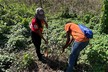
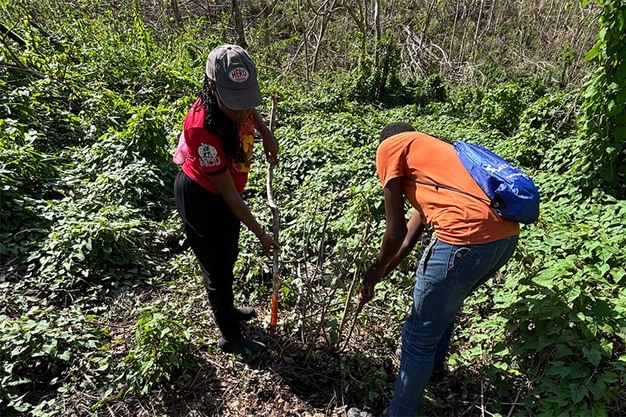
Twenty-five students from NCU's Department of Biology, Chemistry, and Environmental Science worked with faculty members and local residents on December 2 to plant 100 breadfruit trees in a three-mile basin in the Cave district. The area is surrounded by ponds that help maintain soil moisture.
 © Northern Caribbean University
The seedlings were donated by the nonprofit organization Trees That Feed Foundation, which works with communities through agroforestry programs.
"In Cave, we lost trees, including fruit trees, during the hurricane," said project lead Nadia Washington-Daley, lecturer in the Department of Biology, Chemistry, and Environmental Sciences and a resident of the community.
"The breadfruit tree was the obvious first choice for our pilot project because it is a staple that directly improves food security for community members," she explained. "By partnering with groups like the Trees That Feed Foundation, we are not just planting trees; we are laying the groundwork for long-term economic and nutritional stability."
Washington-Daley said the university will monitor the trees to ensure they establish successfully and continue providing benefits for the community.
The initiative forms part of a reforestation and agroforestry strategy designed to restore vegetation while supporting local food systems. Around 60 per cent of the trees planted will be fruit-bearing varieties, including breadfruit, ackee, and mango. The remaining trees will consist of native timber and ornamental species.
The project will include soil analysis to determine suitable tree species for each location and partnerships with the Jamaica Forestry Department, the National Environment and Planning Agency (NEPA), and Trees That Feed Foundation.
Plans are in place to establish an agricultural nursery at NCU by mid-2026 to support plant propagation. Larger planting campaigns are expected to begin in late 2026 during the rainy season, with planting and monitoring continuing into 2027.
University leaders said the project is part of the CNASAHN Serves framework, which integrates academic work with community engagement.
"We are using our academic knowledge in the sciences to heal the land and support our neighbors," said Dr. Caroline McLean, interim dean of CNASAH.
Residents are expected to take part in planting, tree selection, and maintenance activities as the program expands across western Jamaica.
Source: Seventh-day Adventists