The current state of the Ukrainian blueberry industry is stable, but statistical information has been lacking in recent years, says Oleksandr Pukshyn, sales deputy for Ukrainian blueberry exporter Blue Berry LLC: "According to the last official statistics in 2021, there are around 5,500 ha of planted blueberries in Ukraine, mostly concentrated in the Central and Western regions. While the full-scale invasion has prevented new 'mega-players' from entering the market, we describe the current state as horizontally stable, with vertical growth. Acreage remains steady, but productivity per hectare is rising as younger plantations reach full maturity. By the end of 2026, we expect actual statistics provided by the Ukrainian Blueberry Growers Association in close cooperation with the Ukrainian Ministry of Agrarian Policy to reflect this maturing yield."
Pukshyn emphasizes that the Ukrainian blueberry industry has been resilient during the war. "Despite ongoing war-related challenges, the sector has demonstrated remarkable adaptability. The main production regions have maintained operational activity, but the industry has shifted from a phase of rapid expansion to a phase focused on optimization and efficiency. Companies have restructured logistics and export routes to ensure the 'Made in Ukraine' brand remains a stable fixture in the European market."
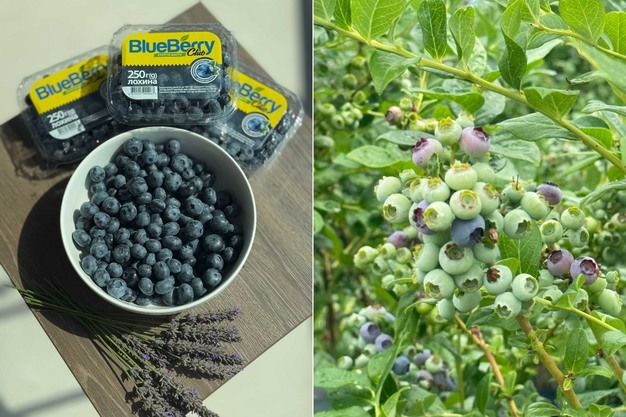 © Blue Berry LLC
According to Pukshyn, Ukrainian exporters are mostly investing in the post-harvest process at the moment: "Ukrainian investment opportunities currently mirror the European landscape, as we face shared global challenges. Producers are focusing on risk mitigation and de-risking operations. Key investments include the latest sorting and freezing facilities to ensure zero-rejection rates in the EU. Investing in solar energy and industrial battery storage to maintain the cold chain during grid instability. Shifting toward modern mid- and late-ripening varieties that offer superior crunch, transportability, and longer shelf life to extend the export window and satisfy Tier-1 retail requirements."
With Russia still attacking the Ukrainian infrastructure, blueberry exporters can no longer rely on the power grid, Pukshyn explains. "The full-scale invasion presented unprecedented operational hurdles for all Ukrainian businesses. Our strategy has shifted from volume-chasing to precision farming to address several critical factors. We have a dependence on the power grid, as irrigation and industrial cooling of berries require a stable power supply, which is a challenge due to the shelling of infrastructure. Then there's the labor shortage; Mobilization and migration have caused an acute shortage of berry pickers, which is critical for manual harvesting."
"On top of that, we have to deal with the continuation of full-scale military operations, a steady decline in the purchasing power of the population, and a lack of qualified personnel. These main factors significantly affected the general activities of all Ukrainian companies and shifted the focus on the new technologies in automatic picking machinery, or solar energy to generate a power grid for their own purposes during the high season."
The main export destinations for Ukrainian blueberries have also changed, which is also thanks to a better reputation for Ukrainian produce in general, Pukshyn states: "Main importers of our produce are Dutch, after substituting the Polish importers who had been our main buyers for four or five years in a row. This shift mainly happened due to greater recognition and a better reputation of Ukrainian growers and exporters, who proved a sufficient level of product, communication, and competence. Also, Polish boycotts and the blocking of the Ukrainian border in 2024 had their own impacts on our growers, as we realized all difficulties and the necessity of searching for new final markets and direct customers."
All of this has caused a significant change in imported volumes per country, Pukshyn elaborates. "As a result, the end of the 2025 season saw the Netherlands importing 990 tons of blueberries, which is a 34 per cent increase from the previous season. Poland imported 660 tons of our blueberries, which was 30 per cent lower than the year before. Georgia bought 610 tons, which was 45 per cent more than in 2024, while Great Britain imported 570 tons, which was a 45 per cent increase. For Germany, there was a 20 per cent decrease in Ukrainian blueberry imports, while Spanish imports dropped 10 per cent to 225 tons."
Looking at 2026, Pukshyn thinks the focus will be on a couple of factors: "For one, the EU will remain the primary export destination. Meanwhile, we expect to increase the yield per hectare for our blueberries. This means we'll also invest in modern varieties with improved transportability and longer shelf life. On top of that, there will be greater mechanization and a reduced dependence on manual labor, all with more professional agronomic management."
"The Ukrainian blueberry sector is no longer just surviving; it is optimizing. The goal for this season is to prove that Ukraine is a reliable, high-tech, and systematic partner for the European food grid. Success in 2026 will be measured not just by the tons exported, but by the number of direct, long-term contracts signed with Tier-1 European retailers," Pukshyn concludes.
For more information:
Oleksandr Pukshyn
Blue Berry LLC
Authorized member of Ukrainian Blueberry Growers Association
Tel: +38 067 404 22 22
[email protected]
www.blueberry.ua
www.blueberry.org.ua