An overflowing room of agricultural producers, association leaders, and policymakers gathered this week for the ag wage reform press conference and roundtable discussion, underscoring the urgency and national scope of the need for permanent reform to the Adverse Effect Wage Rate (AEWR).
Speakers representing dozens of commodities across six states addressed the crowd, collectively urging Congress and federal policymakers to codify the interim final rule related to the AEWR and enact permanent changes that allow farms to plan with certainty, secure seasonal labor, and protect domestic food production.
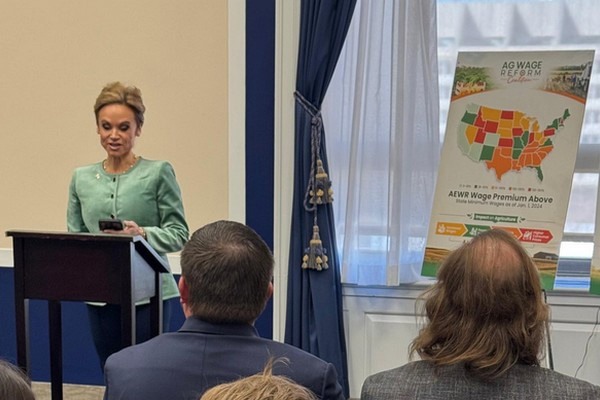 © Ag Wage Reform CoalitionLinda Pryor, a farmer from North Carolina, outlines the risks to domestic food production without permanent reform to the Adverse Effect Wage Rate.
The coalition now represents 36 agricultural organizations across nine states, speaking on behalf of more than 20,000 farmers who rely on over 380,000 temporary H-2A workers nationwide, at a cost exceeding $5 billion annually in wages.
Throughout the morning's roundtable, growers detailed:
- Rapidly escalating wage mandates that outpace market realities
- The inability to plan multi-year crop cycles under fluctuating wage formulas
- Increased financial risk to family farms and rural communities
- Growing dependence on imported food when domestic production becomes unsustainable
Producers emphasized that American farmers are not seeking lower wages, they are seeking fair, predictable, and stable wages that protect:
- Farms
- Farmworkers
- Main Street rural economies
- The integrity of the U.S. food system
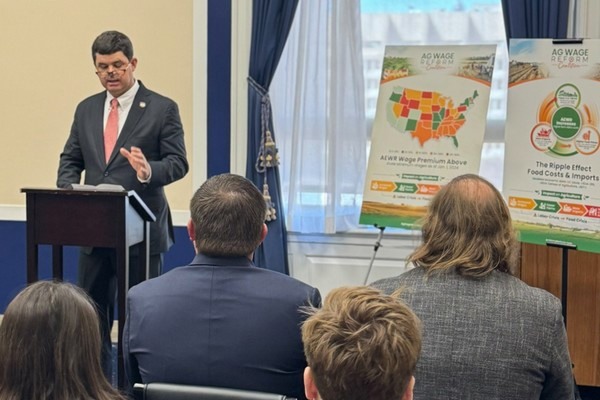 © Ag Wage Reform Coalition
Sam Watson, Georgia farmer and State Senator in the Georgia General Assembly, speaks during the Ag Wage Reform press conference on February 24.
In addition to the press conference and roundtable, coalition members spent the day meeting directly with policymakers to reinforce the urgency of action. Representatives conducted meetings with more than 30 Senate and House offices, as well as with officials at the U.S. Department of Labor and members of the Senate Agriculture Committee. These conversations further highlighted the immediate need for clarity and permanence in federal wage policy for agriculture.
Without permanent reform, speakers warned that domestic fruit and vegetable production, along with specialty crop industries including horticulture and tobacco will continue to decline, food imports will increase, farms will close, and consumer food prices will rise.
"This is not a partisan issue, it is a food security issue," said Sam Watson, a farmer from Georgia. Jason Rodgers of Titan Farms in South Carolina reiterated. "We are asking for stability. We are asking for certainty. We are asking for policies that allow American farms to remain viable while continuing to provide lawful employment for hundreds of thousands of workers," he said.
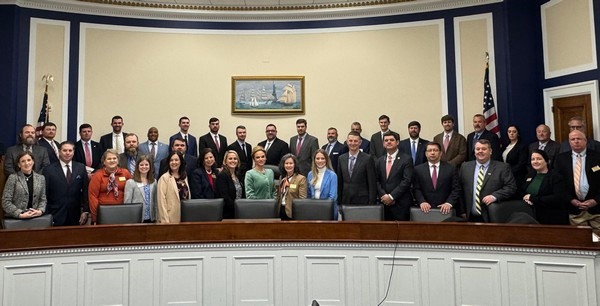 © Ag Wage Reform CoalitionReps from GA, NC, SC, TX, FL, WA, MI, AL, VA and dozens of orgs.
Ag wage reform will continue engaging lawmakers from both parties to advance permanent legislative solutions that codify the interim rule and restore long-term planning certainty to the specialty crop industry.
 For more information:
Melinda Goodman
Ag Wage Reform Coalition
Tel: +1 (414) 469-5524
[email protected]
https://agwagereform.com/