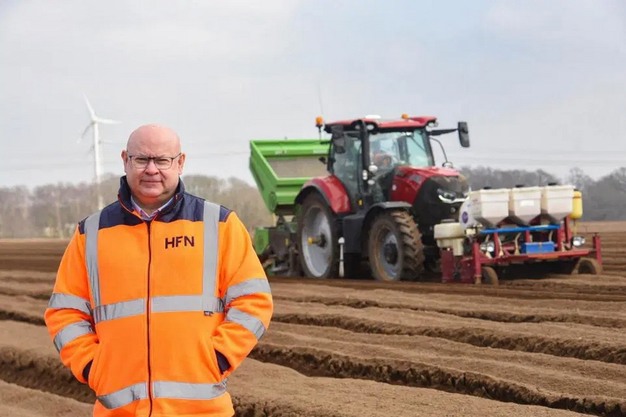
Andrew Francis, managing director of Home Farm Nacton near Ipswich, Suffolk, advocates a collaborative approach to new potato variety development.
"I think it is really important that growers can be involved in the development of a new variety as soon as possible," he says. "It means that both a variety's potential and any problems can be identified as soon as possible, but it needs to be a collaborative approach to make sure all partners get the most out of it. A trial might be going well, but after three or four years, a problem might come out of the woodwork."
Francis has previously worked with McCain to trial new varieties under a supported area payment that reflects the risk and cost of planting. He is currently working with several packers, including Branston, Manor Fresh, Burgess Farms, and Greenvale.
 © GB Potatoes
The farm is also collaborating with Manor Fresh on behalf of Marks & Spencer to enhance Maris Piper, which continues to see consumer demand. While packer and retailer backing is essential, Francis also values engagement with fellow growers conducting trials.
"Workshops and open forums mean you can learn a lot from each other, identify problems, and discuss possible solutions."
Francis chairs the LEAF Marque Technical Advisory Committee, comprising growers, packers, retailers, and environmental organisations. He says collaboration across the supply chain helps ensure environmental standards improve without undermining farm economics.
In selecting new varieties, he highlights market demand as the first requirement.
"Firstly, there has to be a market for a new variety, so taste, nutritional quality, and processing or cooking quality are very important."
He also looks for resilience. "Then we are looking for a variety that is robust and resilient. In particular, resilience against pests such as PCN is very important at a time when threats are increasing, and the number of chemical controls is reducing. As ever, resistance to blight is also important."
Francis notes that reduced chemical controls coincide with more variable weather patterns.
"In the last few seasons, we have seen late and wet springs; then there was last year's drought, and it has been one of the wettest starts to the year on record. We can now expect to have to endure at least one extreme weather event or pattern in every growing season. What makes it challenging is not knowing whether that will be too much or too little water, and when in the season there will be a weather or climate problem."
Despite the risks, he believes potato production continues to offer opportunities.
 © GB PotatoesFor more information:
GB Potatoes
Tel: +44 (0) 1507 353774
Email: [email protected]
www.gb-potatoes.co.uk