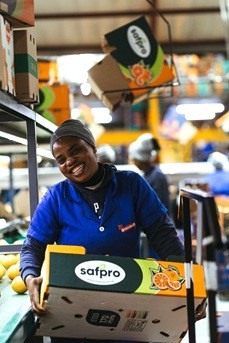
 © SAFPROFor close to thirty years, Safpro, South African Fruit Promotors, has been representing South African citrus, pomefruit, and grape farmers on the global stage. They are, as every year, to be found at the South African Pavilion of Berlin Fruit Logistica.
"We've been very fortunate to partner with the majority of our growers for between 25 and 27 years," says Craig Jensen. "We've avoided the strategy of going into production because we feel like that would be going into competition with the growers and farmers with whom we've worked for a long time. It's a very longstanding relationship that we have with our farmers - we regard each other as partners in the business. They produce, and we commercialise the product."
The majority of their grower base entrusts Safpro with their entire crop, "so you've got small and big and pretty and ugly," he remarks, "and everything has to find a home."
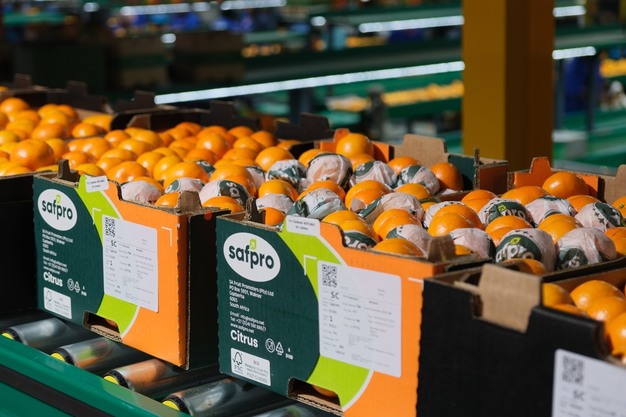
The increase in South Africa's citrus crop puts substantial pressure on exporters like Safpro: increased demand, he says, can also be a double-edged sword. "A dramatic reduction, for example, in the supply of Brazilian juice oranges has seen increasing prices. In turn, the increasing prices have seen some customers replacing orange concentrate as the base for some of their product lines. At the same time, the citrus industry in countries, including Egypt, has invested heavily in Valencia orchards and juicing capacity. So increased pricing sometimes results in a dropping demand, with increasing investment and capacity leading to potential oversupply."
Jensen observes that the excess production would likely then spill into the fresh segment.
"I'm concerned that a lot of people are making long-term decisions on the current juice pricing. I'd be surprised if it lasts another year or two. We saw already the pricing of orange juice concentrate reducing quite dramatically over the last few months."
 © Safpro
Another low Chinese lemon crop expected
The change in shipping protocol means South Africa can now ship quite comfortably a lot of lemons to China. "The change in the protocol has been really positive. Chinese lemon production has increased dramatically over the last number of years, and during the 2024 season, they didn't really need lemons from us. The year after, they had very dry conditions in their lemon production regions, and their lemon crop was down quite heavily in the 2024-2025 season. We are expecting that the Chinese lemon crop will again be down significantly in the 2025/26 season, so it makes for good growth in markets for us."
From a farmer's perspective, he explains, what's difficult is that the farmer builds up infrastructure and employs labour. "The cost of running that infrastructure means they need to put units through over a longer period of time. So, the earlier the citrus farmer can start in, say, March, and the later he can finish towards the end of September and October, the bigger the window of opportunity."
The challenge is that the main European demand is for South African citrus arriving at the end of August, beginning of September. "Sales pick up from basically when the Northern schools go back or European schools re-open. When I talk to my Spanish clients, they'll tell me that if they take the total sum of all of the citrus they sell in July and August, which is Southern Hemisphere fruit, they sell that same volume in one week in September once the schools have reopened."
 © Potentieel
Northern Hemisphere summer citrus sales are challenging
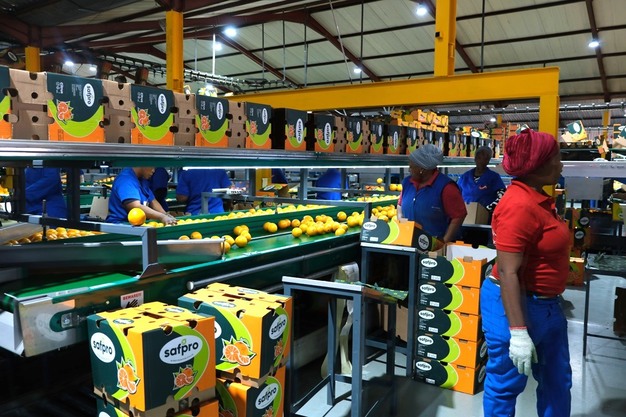
Citrus sales in July and August, when a very large volume of fruit arrives in Northern Hemisphere markets, saturated with a lot of their local products, are probably 10% of sales volumes in a month like October and September.
Jensen continues: "It's extremely complex trying to balance the cost of running their operations and their overheads, and at the same time trying to meet the needs of the market. That's where product development becomes very important. We need to develop citrus varieties that are more attractive to the consumer profile buying in July and August."
The fruit space is inevitably going to become increasingly competitive. "There are many challenges, I believe, that are going to face the industry in the coming years, so we partnered with Variety Innovation Africa, linked with a number of varietal development companies around the world, which are quite heavily focused on developing new citrus varieties."
 © Potentieel
Expanding Asian market for South African pomefruit
Slowly, without fanfare, South African pomefruit has been forging ahead, helped by changing dynamics in global trade during COVID.
"I think during COVID markets like the Middle East swung from South American suppl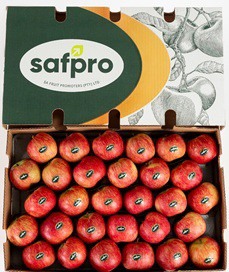 © Safproy because of shipping issues and costs to South African supply. That seems to have stuck to an extent with a far bigger volume of pomefruit going out."
Right: Fuji Red
The Asian market, including China and India, certainly seems to be growing, he remarks. "Our eating quality, in my experience, is really good. We don't have the climate for the very large apples that a lot of our competing countries with far colder winters produce. But certainly, what we lack in size of the fruit, we make up for in the eating quality of the fruit."
Duties on South African fruit going into India are very high. "The risk can be reduced, and the values improve if we could get into a better position from a duty perspective. I think the next step is to get the duties reduced so that the product can hopefully be more affordable to consumers."
For more information: Craig Jensen
Safpro
Tel: +27 41 581 0886/7
Email: [email protected]
www.safpro.net