Fruit variability is real and has a big impact on the supply chain as it results in under mature fruit, overmature fruit, and uneven ripening. However, with the right tools, it is measurable and manageable. Historically, the industry relied on experience, intuition, and small destructive samples. "While these tools aren't wrong, they are no longer enough for today's production systems, logistics speeds, and consumer expectations," says Galen George, Director of Applied Science at Felix Instruments. Non-destructive measurement, representative sampling, and robust modeling are reshaping how maturity and freshness are understood across the industry.
With that in mind, Felix Instruments has developed fruit quality meters, playing an important role in determining the ripeness of fruit and making decisions on the optimal time to start harvest. "Over the years, we've developed quality meters for a wide range of fruit crops, covering both global and locally customized applications," commented George. At its core, a quality meter helps growers see what's happening inside the fruit, not just what's visible from the outside.
Benefits for growers
Because fruit is naturally viable, differences occur from tree to tree, within the same canopy, and even within a single fruit. "Traditional sampling methods – often five or ten destructive samples per block – simply don't capture that variability." The non-destructive meters that have been developed by Felix Instruments allow growers to:
- Sample far more fruit without destroying it.
- Understand true maturity distributions instead of relying on averages.
- Identify variability early in the season.
- Make more confident harvest-timing decisions.
"Instead of guessing whether an entire block is ready, a quality meter allows growers to map maturity across orchards and harvest with much greater precision."
 © Felix Instruments
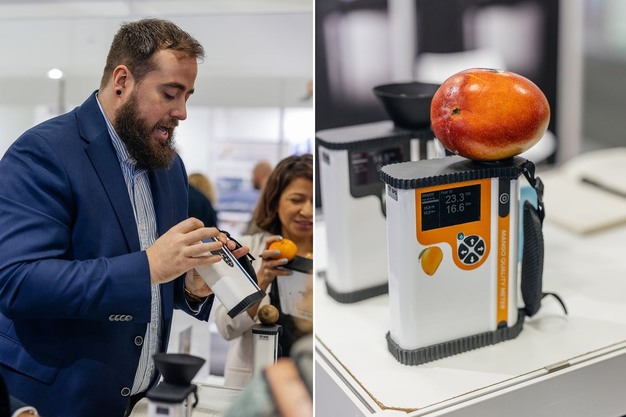
Left: Galen George explains more about one of the company's fruit quality meters. Right: Mango quality meter.
Measuring technology
The instruments use near-infrared (NIR) spectroscopy, which allows light to penetrate the fruit and capture information about its internal composition. Depending on the commodity and model, measurements can include dry matter, soluble solids content (Brix), Acidity and pH, internal color, and other internal quality attributes. "Each scan links spectral data with high-quality laboratory reference measurements—such as oven drying for dry matter or refractometry for Brix—allowing us to build robust predictive models," explained George.
Standardized versus specific models
Commodity-specific meters with pre-loaded global models have been designed for crops like avocados, mangos, kiwifruit, and table grapes. These are part of the F-751 series and are built using large, diverse data sets that span multiple growing regions, cultivars, and seasons.
In addition, the F-750 Produce Quality Meter serves as a flexible NIR platform used to develop custom or localized models. "With the F-750, we've supported commodities including apples, pears, citrus, berries, stone fruit, melons, and a variety of regional or specialty crops." This dual approach allows Felix Instruments to support both standardized export programs and highly specific local production systems.
Developing quality meters for new commodities is ongoing and currently, the focus is on berries, different citrus varieties, apples, pears, stone fruit, and proprietary cultivars. "In addition, we are working on developing meters for emerging crops as well as region-specific crops." Because the platform is designed for custom development, models can be built around specific cultivars, microclimates, or maturity targets where global models may not fully apply. This is also regularly done on a private basis.
 © Felix Instruments
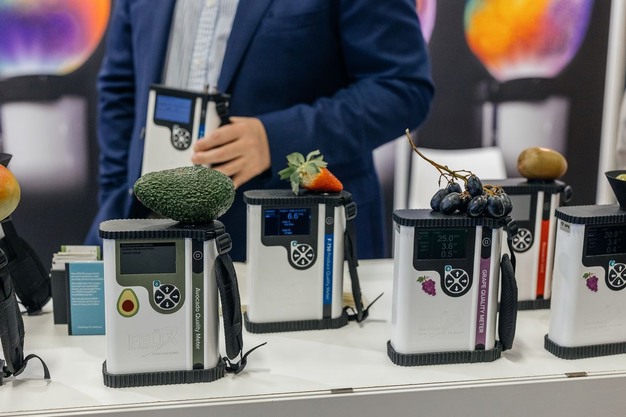
Different fruit quality meters on display at last year's Fruit Logistica Berlin event.
Global demand
Demand for fruit quality meters is truly global and as a result, Felix Instruments works in nearly every major fruit-producing region worldwide. This includes North America, Latin America, Europe, Africa, Asia, and Oceania. Interest is especially strong in export-driven markets, where consistency across long supply chain channels is critical. However, adoption is growing everywhere as quality standards rise and margins tighten.
Positive impact on retailers and consumers
In addition to growers, retailers also feel the impact of fruit variability very directly. "Large retailers have shared with us that a single commodity – such as strawberries – can generate millions of dollars in annual shrink due to inconsistent quality and unpredictable shelf-life," commented George. Across the U.S., retail shrink exceeds $100 billion annually, with fresh produce being one of the largest contributors.
Quality meters can help with:
- Identifying immature or over-mature fruit before distribution.
- Improving shelf-life prediction.
- Reducing extreme outliers that drive most losses.
- Supporting more consistent ripening behavior.
For consumers, this translates into fewer disappointing purchases and a more reliable eating experience—what many refer to as reducing the "fruit lottery."
Fruit Logistica Berlin
As more data is collected, freshness becomes more predictable and more manageable. At Fruit Logistica Berlin, George will share insights from more than 500,000 non-destructive fruit quality scans across multiple crops, seasons, and regions. The session is called "Half a Million Fruit Quality Scans: What the Date Says About the Future of Freshness." Participants will walk away with a clearer understanding how to improve harvest timing, lot management, ripening consistency, and consumer satisfaction.
Attend the session on Thursday, February 5 at 10:20 am. Location: Farming Forward (Hall 3.1 | D-10).
In addition, the Felix Instruments team can be found in Hall 3.1, stand D-33.
 For more information:
Galen George
Director of Applied Science
CID Bio-Science / Felix Instruments
Tel: +1 (360) 833-8835
[email protected]
www.cid-inc.com