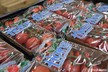
An arctic cold front is pushing temperatures down across Central Florida, prompting strawberry growers in Plant City to activate frost protection measures aimed at preserving future production rather than the immediate harvest.
At Parkesdale Farms, growers are prioritising plant survival. Walking through the fields, grower Gary Parke pointed to strawberries close to harvest that are expected to be lost to the cold. "Here's what we are going to lose, but here's what we are going to save," Parke said.
In Florida strawberry production, freezing conditions often require what growers refer to as a sacrifice. Berries that are days away from harvest may not survive low temperatures, but protecting the plants ensures that blossoms and later fruit sets remain viable. "We are going to lose the next few days, but we are going to save the next month," Parke said.
Growers rely on overhead irrigation as their main frost protection method. Although it appears counterintuitive, applying water during a freeze helps maintain plant tissue at a stable temperature. "See, the strawberries can handle 32 degrees. They can't handle below 32. So if you turn the pump on and get the warm water and the water, of course, freezes at 32, you get a nice 32 degrees warm blanket, and we save as much crop as we can," Parke explained.
As the water freezes, it releases heat, creating an ice layer around the plant that keeps tissue temperatures from dropping below the freezing point, even when air temperatures fall into the 20s. The approach is widely used in open-field strawberry production during freeze events.
Parke acknowledged the operational cost of frost protection. "No farmer wants to turn on the water," he said. "You don't want to lose the sleep, you don't want to lose your diesel." For growers in Plant City, the economic stakes are high, as strawberry production is concentrated in a short seasonal window, with most annual revenue generated within about four months. Losing part of that window affects farm finances. "It's going to hurt. If I think about it, it would hurt more," Parke said. "But, I've been doing this for a long time, and I just care not to think about it."
Parke also noted that cold conditions can influence fruit characteristics once normal temperatures return. According to him, strawberry plants produce additional sugars during cold stress as a natural protective mechanism for seeds, which can result in sweeter fruit.
As cold conditions persist, growers are continuing to monitor temperatures, irrigation systems, and pumps in the fields. While near-term harvest volumes are affected, the objective remains to maintain continuity of supply later in the season.
Source: Fox 13 Tampa Bay