Citrus greening disease (Huanglongbing or HLB) is a bacterial infection of citrus plants and in the U.S., it was first detected in the state of Florida where it has had a devastating effect on the state's citrus industry. Once infected, most trees die within a few years as there is no cure. The disease is also present in California. From time to time, the USDA provides updates on the expansion of the quarantined area. But how has HLB developed in California in recent years and how serious is it threatening the state's citrus industry?
The tiny insect that spreads citrus greening is called the Asian citrus psyllid (ACP). It arrived in southern California in 2008. Since then, the disease has spread, leading to quarantines and the destruction of infected trees. However, so far, infections have been restricted to residential areas and backyards with ongoing efforts to control the spread.
Expansion of quarantined area
"Only two years ago, in the fall of 2023, HLB was first detected where I live in Ventura County," says David Holden, owner of Holden Research and Consulting in Ventura County, a key lemon growing region along California's southern coast. As soon as the first infected tree was found in Santa Paula (Ventura County), the California Department of Food & Agriculture declared a quarantine area. The detection requires a mandatory five-mile radius quarantine area around the find site to restrict the movement of citrus fruit, trees, and related plant material. Ventura is one of many counties in California where acreage has been placed under quarantine. This quarantined acreage continues to increase as the number of infected trees expands slowly. As of December 15, 2025, 3,189 square miles were quarantined in southern California, equaling two million acres. Source: https://maps.cdfa.ca.gov/QuarantineBoundaries/HLB/HLB_PQM_Overview.pdf).
 © CDFA
Quarantine area, effective Dec. 15, 2025. Source: CDFA.
Impact of quarantine on growers
While no commercially grown trees have been infected, growers are living with the constraints of the quarantine every day. An approved insecticide in the form of a pre-harvest spray has to be applied before harvest. After application, growers have two weeks to harvest their fruit.
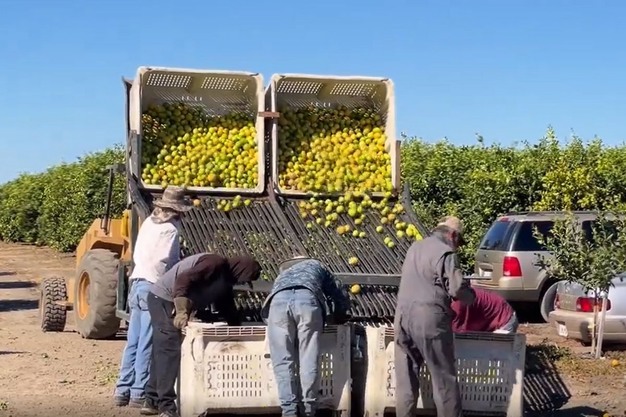
In addition, growers who grow fruit in the quarantine area but want to pack the fruit outside of the quarantine area, need to clean the fruit in the picking bins in one of several ways, an example of which is to run the fruit in the bins over a shaker that gets rid of the leaves before it can be transported outside of the quarantine area. Flatbed trucks transporting citrus from a quarantine area need to be covered with netting to keep any ACP from leaving the bins. All these measures are taken to get rid of any material that could spread the disease with leaves being the big concern as they tend to carry ACP. "All of this significantly adds to the costs for growers," commented Holden.
 © Holden Research & Consulting
Separating leaves from fruit to prevent the spread of HLB.
Increased competition in lemons
Those added costs are hard to swallow for an industry that has been faced with so many headwinds already. "I live in Ventura County, which is predominantly a lemon growing area. This region has been faced with bad market conditions in the past three years," he shared. In the past, this coastal region benefited from year-round lemon production. As a result, lemons were the county's number one crop for many decades. However, increased competition from California's San Joaquin Valley as well as the southern hemisphere have increased supply and caused lemon prices to significantly drop. Given the unfavorable outlook for Ventura County's lemon industry, growers increasingly take out lemon trees and replace them with other crops like avocados. As a result, the value of Ventura County's lemon crop decreased from $259 million in 2015 to $118 million in 2024, according to the California Department of Food & Agriculture.
While citrus greening has significantly added to the costs for growers, HLB is not an immediate threat to the California citrus industry. "This is a very different environment from Florida and not as conducive to HLB expansion," said Holden. Florida is very humid and wet, but California doesn't have a tropical climate. "We have very different seasons with warm and cold weather. Even with the detection of HLB, there hasn't been any panic in the industry, but the impact of managing it is a burden on growers."
 For more information:
David Holden
Holden Research and Consulting
[email protected]