The Ministry of Production of Mendoza released the 2025/26 plum harvest forecast, prepared by the Directorate of Agriculture.
The province is projected to produce 72,879 tons of plums. This figure is based on an initial estimate of 80,956 tons and accounts for contingencies in the final volume. A total of 696 trees were assessed, and more than 11,600 fruits were measured.
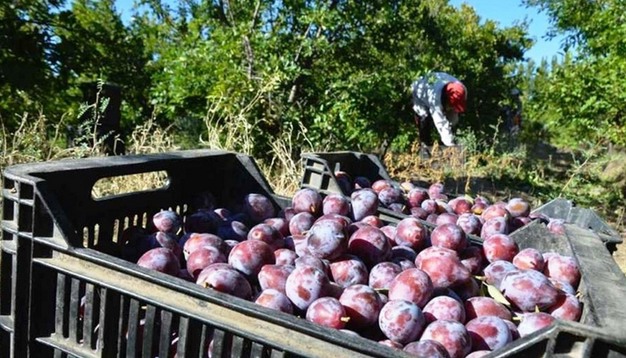 © Gobierno de Mendoza
The territorial analysis reveals a strong concentration of production in the South oasis, which initially accounts for 72,122 tons, representing 89% of the provincial total. The Eastern oasis accounts for approximately 7%, while the Northern and Uco Valley areas make up the remainder, with smaller shares.
The D'Agen variety remains the most common, both in planted area and projected volume.
Peach production is projected to reach approximately 110,685 tons, in line with average levels in previous seasons. A total of 1,518 trees were evaluated, considering all fruits, and 25,300 fruits were measured.
 © Gobierno de Mendoza
The document states that the Uco Valley accounts for 57% (63,367 tons) of the production, the South zone for 30% (32,655 tons), and the East and North zones for 13% (14,663 tons).
Harvest forecasts for the 2025/2026 season estimate 105,000 tons of peaches for the industry, accounting for the potential negative impact of the severe storm that hit the South zone on December 20. However, these figures reflect an average production year, with stability in the sector's expectations," said Alfredo Draque, the province's Director of Agriculture.
The report also analyzed parameters such as weight and diameter to forecast the peaches' potential destination within the factory.
The large fruit, exceeding 57.1 mm, is primarily used for canned fruit halves and accounts for 72% of the estimated total production at 79,693 tons. Conversely, small fruit (less than 57.1 mm) accounts for 28% of the total, approximately 30,992 tons, and is suitable for pulp.
According to the report, the areas with the highest fruit density are the North (254,977 units per hectare) and Valle de Uco (185,469 units per hectare), followed by the South (168,106 units per hectare) and the East (164,992 units per hectare).
For more information:
Government of Mendoza
www.mendoza.gob.ar