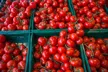
A tomato production partnership between the West Africa Food System Resilience Project (FSRP) and agribusiness firm FarmMate Ltd has completed a first-round harvest of about 240 tons of tomatoes in Ghana's Upper East Region. The harvest is part of dry-season production aimed at addressing recurring supply gaps and price fluctuations between December and May.
FSRP is a program of the Ministry of Food and Agriculture and is supported by the Government of Norway and coordinated by the World Bank. The initiative focuses on strengthening the local tomato value chain through dry-season cultivation and improved market linkages.
Within the program, tomatoes are produced using climate-smart practices supported by FSRP. Farmers receive improved seed varieties, blended fertilisers with micronutrients, organic manure, crop protection products, and ongoing extension advisory services. FarmMate complements this support with close field monitoring, resident agronomists, and a guaranteed offtake of harvested tomatoes.
Produce from farms in the Upper East Region is transported within 24 to 36 hours to markets in the Greater Accra Region, including Agbogbloshie and the Central Business Market, as well as outlets such as Palace Mall and Shoprite.
The FSRP–FarmMate collaboration covers about 81 hectares nationwide, with around 45 hectares located in the Upper East Region. Roughly 100 farmers are involved across Zebila in the Bawku West District, Pwalugu in the Talensi District, the Tono Irrigation Scheme, and Navrongo in the Kasena Nankana District. Additional locations include Ningo-Prampram, Okere, Kwahu East, the Akumadan Irrigation Scheme, and the Asunafo South District.
Beyond FarmMate, the broader FSRP Tomato Support Program operates in 20 districts across six regions, involving about 1,500 farmers, with women accounting for 40 per cent of participants.
Current yields average around 10 tons per hectare, with projections of up to 15 tons per hectare by the end of the 2025 dry season. The overall FSRP target is 6,000 tons of tomatoes by the end of the intervention.
District Director of Agriculture for Bawku West, Diana Akumanue, commented on the marketing system. "We are very happy because the tomatoes are weighed and farmers are paid according to weight, unlike the old system where market queens determined prices," she said.
Beneficiary farmer Asigma Awafo also referred to changes in production and marketing. "For the first time, marketers are weighing our tomatoes and paying us fairly. It has increased our income compared to the past," she said.
According to FSRP Project Officer Dr Gabriel Owusu, tomato remains the most consumed vegetable in the region, while a large share is imported. FarmMate noted ongoing challenges, including grazing pressure, fencing limitations, water availability, and pest pressure during the dry season.
Tomatoes account for about 40 per cent of vegetable expenditure in Ghana, while only 34 per cent of the 1.4 million tons consumed annually are produced locally. The gap contributes to imports, post-harvest losses of up to 60 per cent, and average yields of 8.3 tons per hectare.
Source: GhanaWeb