Announced on January 4th by French Agriculture Minister Annie Genevard and Prime Minister Sébastien Lecornu, the order suspending imports of several products containing residues of substances banned in Europe was published on Wednesday, January 7th. It concerns 5 substances (fungicides and herbicides): glufosinate, mancozeb, thiophanate-methyl, carbendazim, and benomyl.
The French Ministry of Agriculture has stated that the measure will be presented to the Commission at the next meeting of the Standing Committee on Plants, Animals, Food and Feed on January 20th. It will then have 10 days to reach a decision. "It will be up to the Commission to extend the measure at the European level and lower the maximum residue limits for dangerous substances banned from use in the European Union, in order to put an end to imports of food products treated with these five substances."
Which products are affected?
The order specifies which food products are affected by the suspension of imports, depending on the plant protection substance:
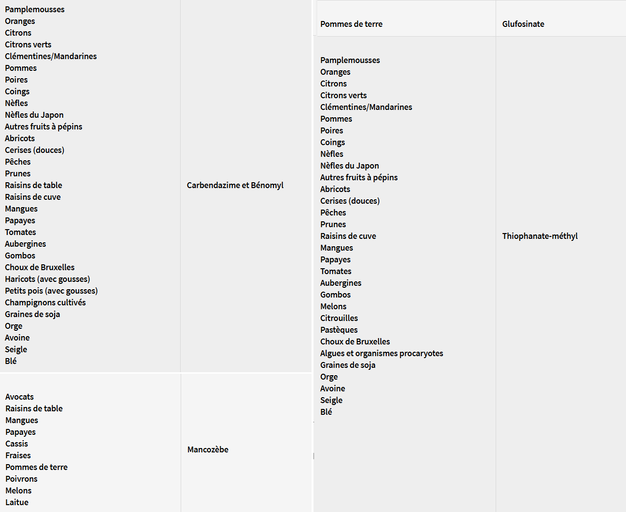 © legifrance.gouv.fr
Safeguard measures already taken in 2016 and 2024
France has taken similar safeguard measures in the past. The most recent of these was the ban on imports of fresh fruit and vegetables treated with thiacloprid (a substance banned for use in the European Union since 2020), introduced by the Order of February 23rd, 2024. This measure was subsequently included in European regulations in May 2025. The previous ban dates back to 2016, when France also banned imports of cherries treated with dimethoate, before the European Union extended the ban to the entire continent in 2021.
Reinforcement of border control brigades
The decree also includes reinforced controls by a specialized brigade to check compliance with maximum residue limits for food products not covered by the emergency measure, according to the French Ministry of Agriculture.
A measure that is not really convincing
On January 5th, the French Apple Pear Association (ANPP) reacted to the measure, citing "a response that misses the real issues for the apple sector," given that "the real distortions of competition are indeed intra-European and remain in full force despite this announcement."
The French Fruit and Vegetable Protection Collective also commented on its X account. "This measure creates an illusion of protection. It does nothing to change the real imbalances suffered by the French sectors," adding that it was above all "a communication for the general public, light years away from the realities and expectations of farmers."
On LinkedIn, FNPFruits nonetheless welcomed this "common sense" decision, even if it is not "the answer to all our problems."