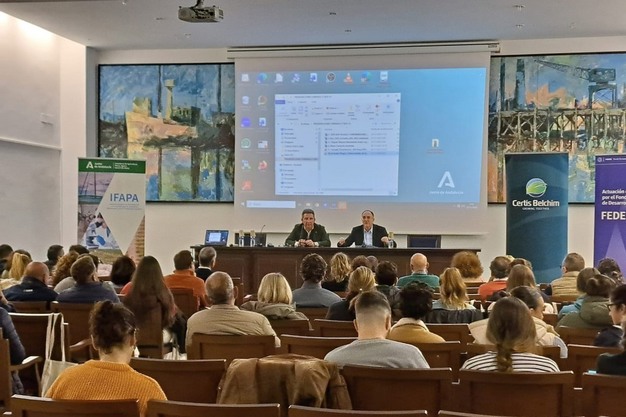
Yesterday in Huelva, a conference on pests and diseases in berry crops in the 24/25 season was opened. The event was attended by nearly 70 participants, including producers and technicians from the sector. It presented results from various trials under the Ifapa project "Management of soil biodiversity, alternatives for controlling diseases caused by soil pathogens, and improving water use efficiency in strawberry cultivation," a project co-funded by European ERDF funds.
 © IFAPA
This work aims to develop sustainable strategies for managing soil pathogens, conserving agroecosystem biodiversity, and promoting healthy, economically viable soils that meet legal standards. Additionally, the researchers plan to create methods to enhance water-use efficiency in strawberry cultivation and decrease nitrogen fertilizer application.
The technical conference in Huelva featured six presentations by researchers and specialists from Ifapa Las Torres (Seville), Alameda del Obispo (Córdoba), and Malaga centers. They discussed various factors influencing pest and disease pressure on berry crops during the 24/25 season.
Trials for studying pests
Berta de los Santos assessed the effectiveness of non-chemical techniques for soil disinfection, while Laura Avivar examined soil disinfection in strawberries, its impact on soil biodiversity, and the occurrence of arthropod pests.
According to expert-provided data, the biological quality of arthropod-based soil (IQBS-ar) in strawberry cultivation was four times lower than in nearby non-agricultural soil. Consequently, there were no statistically significant differences among the various disinfection treatments and the control. Pest presence on strawberries was reduced in biosolarized soil, and in untreated soils, natural enemies contributed to pest control.
 © IFAPA
During the conference, Miguel Talavera addressed the current situation and epidemiological models for managing phytoparasitic nematodes in berry crops. He emphasized that the existing approved control measures are insufficient because they risk increasing phytoparasitic nematode inoculum with each cycle. This could lead to soil populations that become progressively harder to control.
Biodiversity studies in this area also indicated that certain treatments can enhance the soil's natural ability to suppress pathogens and slow nematode population growth, provided new, more effective substances are not approved.
María Camacho discussed the use of beneficial bacteria to improve the nutrition and protection of strawberry crops. She examined how bacterial consortia, including a Pseudomonas strain and a Bacillus strain, could serve as alternatives to synthetic chemical products for both fertilization and biocontrol of strawberry plants.
Following this, M.ª del Carmen Montero explored the role of bacterial genomes in protecting berry crops, and Cristina Castillejo talked about evaluating pathogen resistance and agronomic traits using molecular markers in strawberries.
Researchers developed and optimized genetic tests to easily, at a large scale, identify whether strawberry varieties are resistant or susceptible to four main diseases: Fusarium, Phytophthora, Xanthomonas, and anthracnose.
 © IFAPA
These molecular markers have been used on a collection of strawberry varieties from the Ifapa strawberry germplasm bank in Malaga. This collection includes 138 varieties from diverse geographic origins and breeding programs, spanning historical varieties from the 19th century to current cultivars.
The analysis of this collection has identified which of the five subpopulations (modern, modern exotic, old, founder clones, and hybrids) most commonly contain resistant varieties. This insight is essential for identifying potential parent plants with resistance alleles that can be utilized in breeding programs.
The markers were also tested on commercial varieties from various breeding programs in Huelva. The findings confirm their effectiveness in predicting the susceptibility of these local varieties to the pathogen races present in Huelva.
For more information:
Instituto Andaluz de Investigación y Formación Agraria, Pesquera, Alimentaria y de la Producción Ecológica (IFAPA)
www.juntadeandalucia.es